Moving to Belgium in 2026: The Complete Guide for Expats, Digital Nomads and International Professionals
There is a version of Belgium that exists in the popular imagination chocolate, waffles, beer, and the bureaucratic heart of Europe and then there is the Belgium that people who actually live there experience. The two are not entirely different, but the reality is considerably richer than the cliché.
Belgium sits at the geographic and institutional centre of the European Union, hosts the headquarters of NATO, and has built one of the most comprehensive social security systems on the continent. Its three cities of Brussels, Antwerp, and Ghent offer genuinely distinct lifestyles, and the country as a whole punches well above its weight in terms of cultural output, culinary quality, and quality of urban life.
For expats, international professionals, EU institution employees, NGO workers, academics, and a growing number of digital nomads, Belgium represents a compelling European base. The multilingual environment Dutch in Flanders, French in Wallonia, both in Brussels, with German in a small eastern corridor means the country has been absorbing international populations for generations. English proficiency is high in Brussels, particularly among working-age professionals, and the expat infrastructure in the capital is among the most developed in Europe.
What this guide does is cut past the easy promotion and give you the information you actually need to make this move work. That means real numbers on costs, honest assessments of the bureaucratic journey, current visa salary thresholds, the healthcare system explained clearly, and a genuine picture of what day-to-day life looks like across the country’s main cities.
Is Belgium Right for You?
Belgium rewards a specific kind of expat very well and presents genuine complications for others. Understanding which category you fall into before you book the moving truck is worth the time it takes.
The country works exceptionally well for EU citizens, who can move freely, register with their local commune, and access the full range of social benefits without any visa process whatsoever. It also works very well for non-EU professionals placed in Belgium through multinational employers, EU institutions, NATO, or international NGOs this is a country where employer-sponsored relocations are institutionally well-understood.
Academics, pharmaceutical researchers, and engineers in sectors with established Belgian industry presence (BASF, Johnson and Johnson, Solvay, Umicore, and IMEC are all major employers here) find the professional pathway well-worn.
Digital nomads and freelancers face a more nuanced picture. Belgium does not have a dedicated digital nomad visa in the style of Portugal’s D8 or Estonia’s digital nomad permit. Remote workers employed by foreign companies while living in Belgium operate in a legal grey area that requires careful structuring.
The self-employed route is accessible but administratively demanding, and Belgium’s social security contribution system means that freelancers pay substantial contributions even in the early months of building a client base.
The honest drawbacks are three. First, Belgium has among the highest income tax burdens in the developed world a reality that every financially-aware expat should model before committing.
Second, the bureaucracy is layered and slow, with commune registration, residence permit processing, and social security enrollment each operating on different timelines.
Third, the country’s linguistic division with Flanders and Wallonia operating almost as parallel societies in some respects adds a dimension of complexity to housing searches, administrative interactions, and long-term integration that people who arrive thinking of Belgium as a single homogeneous country sometimes find jarring.
None of this is reason to avoid Belgium. It is reason to arrive prepared.
Belgium’s Main Cities and Where to Live
Belgium is a small country roughly the size of the state of Maryland but its cities offer meaningfully different environments. The choice of where to settle is one of the most consequential decisions of a Belgian relocation, affecting your language exposure, commuting costs, rental budget, and community.
Brussels is the default entry point for the majority of international arrivals, and for good reason. As the capital of both Belgium and the European Union, it hosts a uniquely international population by some estimates, around 30 to 35 percent of Brussels residents are non-Belgian.
The EU quarter, concentrated around Schuman, Etterbeek, and Ixelles, is one of the most densely internationally populated urban areas in the world. The city is effectively trilingual in practice (French, Dutch, and English are all spoken in professional settings), and the expat infrastructure international schools, English-language medical practices, expat associations, international supermarkets is comprehensive.
Areas such as Ixelles, Etterbeek, and Woluwe remain popular with expats and command higher prices. Brussels is not cheap by European standards, but it remains more affordable than Paris, London, or Amsterdam.
Antwerp is Belgium’s second city and, for many expats who discover it, the one they wish they had considered first. It is a genuine world-class port city with a long tradition of cosmopolitanism, a vibrant fashion scene, outstanding food and nightlife, and a historic centre that is among the most beautiful in northern Europe.
Brussels is approximately 12 percent more expensive than Antwerp overall meaning you would need at least €4,242 in Brussels to maintain the same standard of living achievable with €3,800 in Antwerp. For non-EU employees not tied to the EU institutional bubble, Antwerp often delivers a better quality of life at meaningfully lower cost.
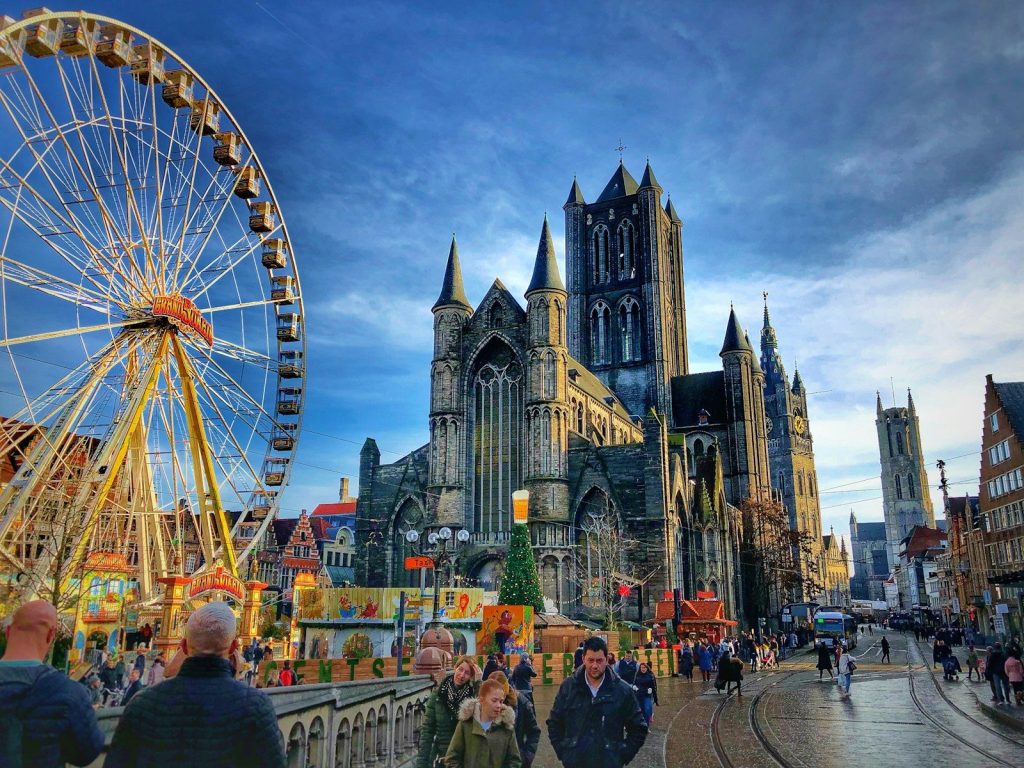
Ghent occupies a particularly appealing middle ground. It is a university city home to Ghent University (UGent), one of the largest and most respected in the Benelux with a young population, excellent cycling infrastructure, a thriving cultural scene, and costs noticeably lower than both Brussels and Antwerp.
A single person’s average monthly total costs in Ghent run to approximately €1,806, compared to €1,953 in Antwerp and €2,104 in Brussels. For academics, researchers, students, and remote workers who do not need the specific institutional environment of Brussels, Ghent is a strong choice.
Leuven deserves particular mention. Home to KU Leuven consistently among the top 100 universities in the world and a burgeoning pharmaceutical and technology cluster that includes companies like IMEC and Janssen, Leuven sits just 25 kilometres from Brussels on a direct rail line.
Rental costs are lower than Brussels, the historic city centre is genuinely beautiful, and the student-driven energy of the city gives it a vitality that surprises visitors expecting something purely academic.
Bruges, Liège, Charleroi, and Hasselt represent the tier of smaller Belgian cities where costs drop significantly and quality of life remains high, particularly for families and retirees.
Liège, in Wallonia, has a gritty industrial character and a passionate local culture; Bruges is one of the most architecturally preserved medieval cities in Europe, though heavily touristic in summer; Charleroi, while sometimes dismissed, offers some of the most affordable housing in the country.
Monthly total costs for a single person in Namur average around €1,226 and in Charleroi around €1,282 a substantial saving compared to Brussels without sacrificing access to Belgium’s rail network and broader infrastructure.
Visa and Residency Options in Belgium
Belgium’s immigration system is more regionalised and complex than many newcomers expect. Work permits and single permits are administered by the three regions Brussels-Capital, Flanders, and Wallonia each with their own administrative portals, processing timelines, and salary thresholds. Understanding this structure is essential before you begin any application.
EU, EEA, and Swiss citizens face no visa requirement. They may enter and stay freely, but must register with their local commune within 90 days of arrival to obtain a residence card. The commune registration triggers Belgian residency, access to the social security system, and all subsequent administrative rights.
Non-EU citizens must navigate one of the following pathways:
The Long-Stay D Visa is the entry visa for most non-EU nationals intending to work, study, or join family in Belgium. It is applied for at the Belgian embassy or consulate in your home country and must be obtained before travelling. Once in Belgium, you proceed to your local commune within eight working days of arrival to formalise your residency and begin the residence permit process.
The EU Blue Card is Belgium’s designated route for highly qualified non-EU professionals. Unlike Germany, where a single national threshold applies, Belgium’s Blue Card salary thresholds vary significantly by region. For 2026, the minimum gross salary requirements are: Flanders €63,586 per year, Wallonia €68,815 per year, and Brussels-Capital Region €56,976 per year (equivalent to approximately €4,748 per month).
These are substantially higher than Germany’s equivalent thresholds, reflecting Belgium’s higher average wage levels. The permit is valid for up to four years and offers a path to long-term residence. For IT professionals, the recast EU Blue Card Directive now permits qualification based on professional experience in lieu of a formal degree, provided three years of relevant experience can be demonstrated.
Full requirements and the application process by region can be found on the Belgian Immigration Office’s official website.
The Work Permit B / Single Permit covers the broader range of employment situations. For 2026, Brussels-Capital has set the highly-skilled worker threshold at €3,703.44 gross per month (approximately €44,441 per year) and an executive threshold of €6,647.20 per month.
Wallonia has set annual figures of €53,220 for highly-skilled workers, €42,576 for junior assignees under 30, and €88,790 for executives. These thresholds are updated annually through Belgium’s automatic wage indexation mechanism, which means they shift every January.
Single permit processing times currently run between three and four months in most regions a timeline that HR teams and individual applicants should build into their planning.
Student visas are tied to enrolment at a recognised Belgian higher education institution KU Leuven, UGent, ULB, VUB, UCLouvain, and others all attract substantial international student populations. Students may work up to 20 hours per week alongside their studies.
Tuition fees at public Belgian universities are heavily regulated and are substantially lower than comparable institutions in the UK or the Netherlands, making Belgium an increasingly attractive option for international students seeking quality education at contained cost.
Self-employed and freelancer routes exist but involve registration with a Belgian social insurance fund (sociaal verzekeringsfonds / caisse d’assurances sociales), a business registration, and the payment of quarterly social security contributions from day one of operation. The administrative overhead is meaningful and is best navigated with the support of a Belgian accountant (boekhouder / comptable) from the outset.
The first administrative step for all non-EU arrivals is commune registration. Non-EU citizens must present themselves to their commune within eight working days of arrival in Belgium, providing a valid D-visa and passport.
This registration triggers your Belgian National Register Number (NRNN), which is the Belgian equivalent of a national ID number and is required for virtually every subsequent administrative interaction opening a bank account, enrolling in a mutuality, registering with the tax authority, and signing a lease. Do not delay this step under any circumstances.
Cost of Living in Belgium: What to Budget
Belgium is one of the higher-cost countries in Western Europe, and it is important to approach the budgeting exercise with current data rather than generalised impressions. Belgium ranks as the 13th most expensive country in Europe, with average per-person annual spending of approximately €20,121, or €1,677 monthly across all regions.
The table below provides a realistic monthly budget breakdown for a single professional across four main city tiers.
| Expense Category | Charleroi / Liège | Ghent | Antwerp | Brussels |
|---|---|---|---|---|
| Rent (1-bed, city centre) | €550 – €750 | €750 – €950 | €850 – €1,100 | €900 – €1,200 |
| Utilities (electricity, water, heating) | €100 – €150 | €120 – €170 | €130 – €180 | €150 – €200 |
| Groceries | €250 – €320 | €280 – €360 | €300 – €380 | €320 – €400 |
| Public transport (monthly pass) | €50 – €70 | €50 – €70 | €55 – €75 | €49 – €65 |
| Health mutuality (supplemental) | €15 – €25 | €15 – €25 | €15 – €25 | €15 – €30 |
| Internet | €40 – €60 | €45 – €65 | €50 – €70 | €55 – €80 |
| Dining out / leisure | €150 – €250 | €180 – €280 | €200 – €320 | €250 – €400 |
| Approximate Monthly Total | €1,155 – €1,625 | €1,440 – €1,920 | €1,600 – €2,150 | €1,739 – €2,375 |
A few line items require specific attention. In 2026, the average monthly rent for a one-bedroom city-centre apartment in Belgium is €851 nationally breaking down to €886 in Flanders, €667 in Wallonia, and €1,118 in Brussels.
Internet costs in Belgium are notably high by European standards the country has consistently ranked among the most expensive in Europe for broadband, and this is worth factoring into your budget explicitly rather than treating as a rounding error.
For public transport, Brussels’s STIB/MIVB monthly pass costs approximately €49, which covers the metro, trams, and buses within the Brussels-Capital Region. SNCB (the national rail operator) connects cities efficiently, though inter-city fares are not as low as Germany’s Deutschlandticket.
A single Brussels-to-Ghent train ticket costs approximately €10, and regular commuters should consider the SNCB’s standard commuter passes, which offer significant discounts over single fare pricing.
Finding Housing and Renting in Belgium
The Belgian rental market has its own conventions, terminology, and legal framework that differ meaningfully from what UK, US, Australian, or South African expats might be accustomed to. Getting the basics right before you sign anything avoids expensive mistakes.
The standard rental deposit in Belgium is two to three months of rent, held in a blocked bank account (either in your name or managed jointly) and returned at the end of the tenancy minus any legitimate deductions.
Agency fees, where an estate agent is involved, are typically paid by the landlord in Flanders and Brussels following regulatory changes; however, in practice some agents still attempt to charge tenant fees, particularly for international arrivals unfamiliar with local norms. Know your rights before engaging an agent.
Leases in Belgium come in two main forms. Short-term leases of up to three years are flexible and renewable but do not offer the same tenant protections as long-term leases. Long-term leases (nine years) provide greater security and limit the landlord’s ability to terminate the contract to specific circumstances.
For newly arrived expats who are not certain of their long-term intentions, a short-term lease with an agreed early termination clause is the more pragmatic starting point.
The main Belgian property and rental portals are Immoweb the dominant platform used by both agents and private landlords and Zimmo, which covers a broader range of listings including short-term and student accommodation.
For Brussels in particular, expat-oriented platforms and Facebook groups focused on the EU and international community often carry listings that do not appear on the main portals, particularly for furnished apartments aimed at short-term international assignees.
Student rooms (koten or koten, derived from Flemish slang for a small room) are a defining feature of housing in university cities like Leuven and Ghent. These are typically small furnished rooms in larger shared houses, with shared kitchen and bathroom facilities, and usually cost €400 to €600 per month inclusive of utilities.
For recent graduates and young professionals seeking affordable entry into the Belgian market, co-living spaces in Brussels and Antwerp have expanded considerably in recent years. Co-living monthly prices in Brussels typically range from €750 to €1,200, with utilities included electric, heating, water, high-speed internet and often community activities.
One practical point that catches many new arrivals: you will need your commune registration certificate (attestation d’adresse / bewijs van woonplaats) to complete your residence permit process, but you need a signed rental contract to register at the commune in the first place.
This interdependency means you should secure your rental accommodation even temporary furnished accommodation before or immediately upon arrival. Signing a lease on furnished short-term accommodation for your first month gives you the address you need to complete the registration chain.
Healthcare and Belgian Social Security
Belgium’s healthcare system is consistently rated among the best in Europe, and for most residents, access to it is both mandatory and relatively seamless once the initial registration is complete. The system operates through a network of approved mutualities (mutuelles in French, ziekenfondsen in Dutch) not-for-profit health insurance funds that serve as the intermediary between you and the national health insurance system (INAMI/RIZIV).
Enrolment with a mutuality is compulsory for all Belgian residents, including non-EU nationals once they have their residence permit. The main mutualities are Mutualité Chrétienne (MC) / Christelijke Mutualiteit (CM), Mutualité Libérale / Liberale Mutualiteit, Mutualité Socialiste / Socialistische Mutualiteit, and the neutral Partenamut (for Wallonia) and Partena Ziekenfonds (for Flanders).
All cover the same legally mandated basic package of healthcare; differences lie in supplemental coverage, administrative efficiency, and English-language support. For expats, Partena in particular has a reputation for solid English-language service.
How the system works in practice: you pay the full cost of a medical consultation upfront (a GP visit typically costs €26 to €35) and then submit the invoice to your mutuality for reimbursement. The reimbursement covers the majority of the cost typically 75 to 80 percent for a standard consultation leaving you with a personal contribution (ticket modérateur) of a few euros.
For hospital treatment, the co-payment system is more complex, and supplemental hospital insurance (a separate product offered by most mutualities and private insurers) is strongly recommended to cover the gap between the INAMI reimbursement and the actual hospital invoice.
In 2026, the average monthly expenditure on healthcare in Belgium is estimated at €82 per person (Flanders €81, Wallonia €74, Brussels €96). This figure includes both the obligatory mutuality contribution and typical out-of-pocket co-payments. Private supplemental health insurance for dental, optical, and hospital coverage typically adds €120 to €160 per year at the basic level.
The Belgian social security system also covers unemployment insurance, pension entitlement, family allowances, and disability. Employees contribute 13.07 percent of their gross salary to social security, with employers contributing approximately 27 percent additionally. These contributions are mandatory and automatic through payroll, and they build entitlement to the full range of social security benefits proportional to your contribution history.

Taxes, Banking, and Money in Belgium
Belgium’s tax system is one of the most important things to understand before you arrive, because the gap between gross and net income here is one of the widest in the developed world, and failing to model it accurately will significantly distort your financial planning.
The federal income tax system applies the following progressive rates for income year 2026: 25 percent on income up to approximately €15,200; 40 percent between €15,200 and €26,830; 45 percent between €26,830 and €46,440; and 50 percent on income above €46,440.
The personal tax-free allowance for income year 2026 is €11,180. On top of federal income tax, each municipality applies a communal surcharge (centimes additionnels / opcentiemen) of between 0 and 9 percent of your federal tax liability. Brussels averages a 7 percent surcharge, meaning a Brussels resident in the 50 percent federal bracket faces an effective combined rate of approximately 53.5 percent.
Add the employee social security contribution of 13.07 percent of gross salary, and the total tax and contribution burden is among the highest in the EU.
This context makes the Belgian Special Tax Regime for Inbound Taxpayers (BBIK Bijzonder Belastingstelsel voor Ingekomen Belastingplichtigen, or RSII in French) extremely relevant for qualifying expat professionals.
The BBIK regime, significantly enhanced through reforms adopted in late 2025 and applying from assessment year 2026, allows employers to reimburse certain costs of international assignment tax-free, reducing the effective tax burden considerably. The regime has an income threshold and requires the employee to have been non-resident in Belgium for a specified period prior to taking up the position.
If you are being relocated to Belgium by an employer, determining whether you qualify for BBIK should be a priority conversation with a Belgian tax advisor (fiscaal adviseur / conseiller fiscal) before you accept the contract terms. The Belgian Federal Public Service Finance (FPS Finance) publishes current rate tables and regime conditions.
Capital gains in Belgium are generally not taxed for private individuals on financial instruments under normal conditions a meaningful advantage for those with investment portfolios. However, a 10 percent capital gains tax on stock gains was introduced effective 2026. There is no general wealth tax in Belgium. VAT (BTW/TVA) is charged at a standard rate of 21 percent.
Banking is straightforward once your commune registration is complete. The main retail banks are ING Belgium, BNP Paribas Fortis, KBC (dominant in Flanders), Belfius, and Bpost Bank. All require your commune registration certificate and a residence permit (or proof of pending application) to open an account.
KBC and Belfius are commonly recommended for new arrivals, particularly those who want solid mobile banking alongside in-branch support. Digital banking options like Wise and Revolut are widely used by the international community for foreign currency management and international transfers, though they cannot fully replace a Belgian bank account for salary receipt, direct debits, and rental payments. SEPA transfers within the eurozone are free and typically process within one business day.
Belgium’s banking infrastructure is reliable and well-regulated. Credit cards and contactless payments are widely accepted, though Belgium’s traditional preference for bank transfer (domiciliëring / domiciliation) for regular payments utilities, insurance, subscriptions means you will want your IBAN established and functional within the first week of arrival.
Work, Digital Nomad Life, and Remote Working
Belgium’s job market is strong in specific sectors and more restricted in others. The country’s GDP is disproportionately driven by services EU institutions, financial services, logistics (the port of Antwerp is one of Europe’s most important), pharmaceuticals, chemicals, and increasingly technology and digital industries. For professionals in these fields, the Belgian labour market offers genuine opportunity.
The EU Blue Card remains the primary pathway for highly qualified non-EU professionals. Given the high salary thresholds particularly in Flanders and Wallonia it is realistically a route for senior professionals rather than early-career workers. The single permit process for other employment categories typically takes three to four months, which means employers must plan well ahead for international hires.
For digital nomads working entirely remotely for foreign employers, Belgium presents the same structural challenge as most northern European countries: there is no dedicated visa pathway, the tax residency rules are triggered by commune registration and physical presence, and once resident you become subject to Belgian tax on worldwide income.
Remote workers relocating to Belgium through an employer should clarify the payroll and social security implications with a specialist immigration and tax advisor before committing to the move.
For independent consultants, establishing a Belgian company (Besloten vennootschap / Société à responsabilité limitée) or registering as a self-employed professional (zelfstandige / indépendant) is the appropriate structural solution, but it comes with the social security contribution obligations described above.
Co-working infrastructure in Brussels is excellent, driven by the high density of international professionals and EU-adjacent organisations. Spaces like Silversquare, which operates multiple Brussels locations, and Belgian co-working networks including BeCentral near Brussels-Central station, cater specifically to the international professional community and offer flexible day-pass and monthly membership options.
Antwerp and Ghent also have growing co-working ecosystems that increasingly attract remote-working expats.
Day-to-Day Life: Language, Culture, and Integration
The language situation in Belgium is one of the defining features of life there, and it deserves more than a passing mention. Belgium has three official language communities: Dutch-speaking Flanders (north), French-speaking Wallonia (south), and the small German-speaking community in the east. Brussels is officially bilingual (French and Dutch), though French predominates in practice and English is widely spoken in professional and international contexts.
For expats settling in Brussels, the linguistic situation is relatively manageable. English proficiency is high among the working-age population, and the EU institutional world effectively operates in English.
That said, administrative communications from the commune, the tax authority, and the social security system will arrive in French (in Wallonia and Brussels) or Dutch (in Flanders), and an investment in the relevant language from early on in your stay will pay dividends that extend well beyond the practical.
In Flanders including Antwerp, Ghent, and Leuven Dutch (specifically the Flemish variant) is the language of daily life, commerce, and administration. English is widely spoken among younger people, but the expectation in professional settings outside explicitly international organisations is that you will, at minimum, be making a genuine effort with Dutch.
Language courses are available through the inburgering (civic integration) programme that is mandatory for non-EU nationals settling in Flanders, through municipal adult education (Centrum voor Volwassenenonderwijs / CVO), and through the NT2 (Nederlands als Tweede Taal) programme which specifically targets Dutch as a second language learners.
In Wallonia, French is the language of daily life, and the same logic applies in reverse. The Alliance Française and Wallangues (Wallonia’s public online language learning platform) offer structured pathways.
Belgian culture has some particular characteristics worth noting. The café culture is deep and genuine Belgium has around 1,500 distinct local beer styles, and the local café (which in Flanders is called a café or estaminet rather than a bar) functions as a genuine community institution.
Cycling culture is mature in both Flanders and Brussels, with dedicated infrastructure and a genuine social dimension around cycling clubs and events. Food is taken seriously Belgium’s restaurant scene, from neighbourhood brasseries to Michelin-starred establishments, is well out of proportion to the country’s size.
Integration into local Belgian life takes longer than many expats expect, partly because the country’s established social infrastructure can mean that local social circles are already well-formed. Expat associations Brussels Expats, InterNations Brussels, and numerous nationality-specific communities provide an immediate social entry point.
The transition from expat social circle to genuine local integration is a longer journey, but those who invest in the language and show sustained interest in local culture consistently report that Belgian friendships, once formed, are among the most loyal and genuine they have experienced.
Transport, Safety, and the Environment
Belgium’s transport network is one of its genuine strengths for daily life, though it comes with some qualifications that are worth knowing.
The national rail network, operated by SNCB/NMBS, connects all major Belgian cities efficiently and at relatively short journey times Brussels to Antwerp is roughly 45 minutes, Brussels to Ghent around 30 minutes, and Brussels to Bruges approximately one hour.
The network also connects directly to Paris (via Thalys, now rebranded Eurostar), London (direct Eurostar), Amsterdam, and major German cities, making Belgium a genuinely excellent base for anyone who travels internationally for work.
Within Brussels, the STIB/MIVB operates a metro, tram, and bus network that covers the main residential and commercial areas effectively. Antwerp has a pre-metro (partially underground tram network) and De Lijn operates bus and tram services throughout Flanders.
Cycling is not merely tolerated in Belgium in cities like Ghent and Leuven, it is the dominant mode of short-distance travel, with well-maintained cycling infrastructure and a culture in which the bike genuinely competes with the car for everyday journeys. Ghent’s pedestrianised city centre, combined with its cycling network, has been cited internationally as a model for sustainable urban mobility.
Car ownership in Belgium carries the usual costs annual road tax (verkeersbelasting / taxe de circulation), mandatory third-party liability insurance (BA-verzekering), and fuel costs. Parking in city centres is expensive and often limited. For expats settling in Brussels or Ghent specifically, the combination of public transport and cycling covers the vast majority of daily journeys without the overhead of vehicle ownership.
Belgium’s safety record is solid. Crime rates are low by international standards, and major cities are safe to navigate. Brussels, like any major city, has specific neighbourhoods that warrant standard urban caution the area around the Gare du Midi/Zuidstation is often cited but the overall security environment is calm and stable. The Belgian Federal Police (Federale Politie) maintains a public crime statistics portal for those who want detailed data by municipality.
On environmental matters, Belgium has committed to ambitious climate targets and the transition away from fossil fuel heating is underway, though progress has been uneven across regions. The Energiewende-style transition is moving at a different pace than Germany’s, but the direction is clear, and new residents will notice the growing prevalence of heat pump systems and solar installations, particularly in newer construction in Flanders.
Bureaucracy, Pitfalls, and Common Expat Mistakes
Belgium’s administrative culture is thorough, layered, and for those who have not dealt with a system where regional, federal, and municipal authorities all have overlapping but distinct jurisdictions genuinely disorienting at first. The mistakes that catch expats out tend to be consistent and avoidable.
Missing the commune registration deadline. The eight-working-day deadline for presenting yourself to the commune after arrival is legal, not advisory. Missing it creates complications for your residence permit application and can trigger administrative difficulties with your employer’s social security registration. Book your commune appointment before you arrive if the system permits it, or go in person on your first working day.
Not having the right documents for commune registration. The commune will require your valid passport, your D-visa (for non-EU nationals), proof of address (a signed rental contract or letter of accommodation from a host), and in some cases employer documentation.
The exact requirements vary slightly by commune, and Brussels in particular has a notoriously complex commune system the Brussels-Capital Region consists of 19 separate communes, each with its own administration. Check the specific requirements for your commune at brussels.be or the relevant Flemish commune website before you go.
Underestimating the gross-to-net income gap. The difference between gross and net salary in Belgium is one of the largest in the developed world.
An employee earning €60,000 gross per year in Brussels, after employee social security contributions of 13.07 percent and federal plus communal income tax, will take home approximately €35,000 to €37,000 net an effective combined rate approaching 40 percent at that income level, and rising further at higher incomes.
Any financial planning based on gross salary comparisons with lower-tax countries will systematically overstate Belgian purchasing power.
Failing to enrol with a mutuality promptly. Mutuality enrolment should happen within the first days of receiving your commune registration confirmation and National Register Number. Without mutuality membership, you are not covered by the national health insurance system and will pay full (unreimbursed) costs for any healthcare. Some mutualities allow enrolment even while your residence permit application is pending confirm this with your chosen mutuality on arrival.
Not understanding the linguistic region of your commune. In Flanders, all official correspondence and administrative interactions are in Dutch. In Wallonia, they are in French. In Brussels, they are officially in both, though in practice French often predominates. Engaging with your commune in the wrong language or more commonly, in English only can result in longer processing times and frustrated interactions on both sides.
Signing a lease without verifying the Attestation d’Adresse process. Your rental contract is what you bring to the commune to register your address. Make sure it is signed, dated, and contains all the required landlord information before you present yourself. An unsigned or incomplete contract will not be accepted.
Step-by-Step Checklist: Before and After Your Move
The following timeline assumes a non-EU citizen applying for either a work permit B or EU Blue Card, with a target arrival date six months out.
Six to three months before:
Identify your visa pathway and confirm with your employer (if applicable) which regional authority handles your permit Brussels-Capital, Flanders, or Wallonia as the processes and thresholds differ. Begin your visa application at the Belgian embassy or consulate in your home country.
Get documents apostilled as necessary criminal background check, birth certificate, academic qualifications. Research cities and neighbourhoods based on your employer’s location and your budget. Begin French or Dutch language learning at a basic conversational level.
Three to one month before:
Confirm your temporary accommodation in Belgium, which you will need for commune registration on arrival. Research mutualities and identify which one you will enrol with Partena, CM, and MC are all expat-accessible options with English support. Notify your home country tax authority of your departure date and intended Belgian residence. Open a Wise or Revolut account for international transfers and currency exchange in the interim before your Belgian bank account is established.
Arrival week:
Present yourself at your commune within eight working days of arrival for address registration. Bring passport, D-visa, signed rental contract, and any additional documents required by that specific commune. Obtain your National Register Number (Rijksregisternummer / Numéro de registre national) and Annex 15 or equivalent residence document.
Enrol with your chosen mutuality using your NRNN. Open your Belgian bank account at KBC, ING, BNP Paribas Fortis, or Belfius. Register with your employer’s HR team for payroll and social security.
Ongoing:
File your Belgian income tax return (aangifte / déclaration d’impôts) annually through MyMinfin, the Belgian tax authority’s online portal. Deadlines vary by complexity typically early summer for employed individuals using the pre-filled return, later in autumn for those who need to make corrections or additional declarations.
Invest consistently in the language of your region. Connect with expat associations Expat.com Belgium, the Brussels Expats community, and InterNations are all well-established starting points.
Conclusion: Is Moving to Belgium Right for You in 2026?
Belgium makes a compelling case for a specific and well-defined audience. For EU citizens, senior professionals in multinational corporations, EU institution employees, NATO staff, academics, and international organisation workers, it is one of the most practical, well-connected, and institutionally supportive bases in Europe.
The healthcare is excellent, the social security system comprehensive, the transport network efficient, and the cultural life richer than the country’s modest international profile would suggest.
The tax burden is genuinely high, and anyone making financial decisions without modelling the gross-to-net reality accurately will be disappointed. The bureaucracy requires patience and methodical preparation.
The linguistic complexity adds a layer of adjustment that is real for people arriving from monolingual environments. And the housing market in Brussels and Antwerp has tightened considerably over the past five years, requiring both early planning and realistic rental budgets.
But for those who match the profile, Belgium tends to be underrated. It is not a country that shouts about itself, which may be why the expats who discover it properly who live in a neighbourhood rather than just the EU bubble, who learn the language, who find the local cafés and cycling routes and village festivals are often the most loyal advocates for it. The country rewards the effort you put in, which is perhaps the most honest thing that can be said about it.
If you are beginning the planning process, start with the Belgian Immigration Office (Dienst Vreemdelingenzaken / Office des Étrangers) for the official requirements by permit type, the Belgian Federal Public Service Finance (FPS Finance) for current tax rates and the BBIK expat regime, and Expatica Belgium for practical daily-life guidance maintained by a community that has been covering the expat experience in Belgium for over two decades.
For tax planning specifically and this cannot be overstated given the complexity of the Belgian system a qualified Belgian tax advisor (fiscaal adviseur / conseiller fiscal) is not optional. It is one of the best investments you will make in the process.