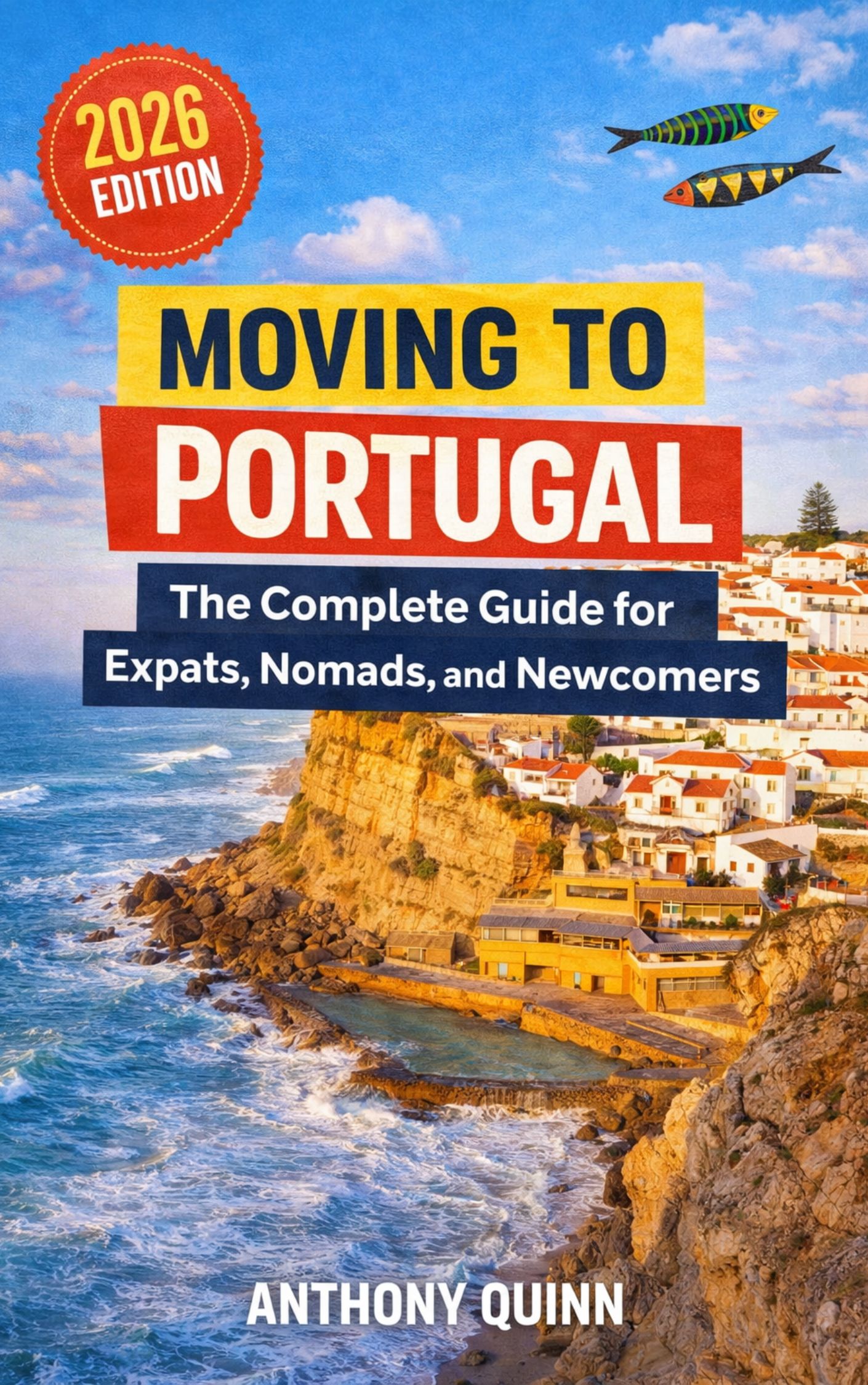
Moving to Portugal in 2026: The Complete Guide for Expats, Digital Nomads and Retirees
Portugal has quietly become one of the most talked-about relocation destinations in the world, and the conversation shows no signs of slowing. Over the past decade, the country has attracted a remarkable diversity of newcomers: American retirees drawn by the affordable cost of living and mild Atlantic climate, British families seeking EU access after Brexit, tech professionals building location-independent careers from Lisbon’s booming startup scene, and investors who recognised early that Portuguese real estate offered genuine long-term value.
The reasons are not difficult to understand. Portugal combines European stability, EU and Schengen membership, a genuinely safe environment, and a quality of life that punches significantly above its economic weight. The weather across most of the country is outstanding Lisbon averages 2,800 hours of sunshine per year, more than almost any other European capital. The food is excellent and affordable.
The people are, by broad consensus, among the most welcoming in Europe toward foreign nationals. And the country has, at various points in the last decade, offered some of the most investor- and expat-friendly tax frameworks available anywhere in the developed world.
None of this means moving to Portugal is without complications. The bureaucracy is real and occasionally exhausting. The language matters more than many anglophone expats initially expect. Housing costs in Lisbon and Porto have risen sharply. And the tax regime, particularly the Non-Habitual Resident (NHR) programme, has undergone significant changes that affect the calculus for many prospective movers.
This guide covers all of it honestly and in detail so that your decision to relocate to Portugal is made with clear eyes and solid information.
Is Portugal the Right Place for You?
Before diving into the practicalities, it is worth being honest about who Portugal suits and who it does not, because the country that works perfectly for a retired couple from Toronto may frustrate a young professional expecting the pace and infrastructure of Berlin or London.
Portugal works exceptionally well for the following profiles:
- Retirees with passive income who want a safe, affordable, climatically pleasant European base with accessible private healthcare and a well-developed expat community. The D7 visa was built for this profile.
- Digital nomads and remote workers earning in dollars, pounds, or euros who want to dramatically reduce their cost of living while maintaining or improving their quality of life. The D8 visa formalises this pathway.
- Investors looking for EU residency alongside a qualifying investment in Portuguese real estate or business, for whom the Golden Visa (ARI) remains relevant despite recent modifications.
- Families seeking a safe, bilingual-friendly environment with good international schools, outdoor lifestyle access, and reasonable proximity to the rest of Europe.
- Lifestyle migrants a category that resists easy definition but typically involves people willing to trade career advancement for quality of daily life, and who find that trade genuinely enriching rather than limiting.
Portugal is a harder fit for those who require a large, diverse job market for local employment (salaries in Portugal are among the lowest in Western Europe), who need cutting-edge specialist healthcare immediately available, or who struggle with administrative ambiguity and bureaucratic delays.
A quick honest assessment:
Pros: mild climate year-round, genuine safety (Portugal consistently ranks in the top ten safest countries globally in the Global Peace Index), affordable cost of living outside prime city districts, strong and established expat communities, EU and Schengen access, high English proficiency in urban areas, exceptional food and wine culture, accessible natural environment.
Cons: significant bureaucratic friction, language dependence outside major cities and tourist areas, rising housing costs in Lisbon and Porto, slower pace of administrative service delivery, recent changes to the NHR tax regime that have reduced the incentive for some income profiles.

The Complete Guide
Understanding Portugal’s Regions and Where to Live
One of Portugal’s most underappreciated strengths is its regional diversity. The country is small enough roughly the size of Indiana that you can reach almost any part of it in three to four hours by car. But within that compact geography, the lifestyle differences between regions are substantial.
Lisbon
Portugal’s capital is the default for many first-time expats and for legitimate reasons. Lisbon offers the best international infrastructure: the strongest concentration of English-speaking services, the widest range of international schools, the most developed startup and tech ecosystem, the best transport connections domestically and internationally, and the largest expat community in the country.
The city sits on seven hills above the Tagus estuary, with an aesthetic that combines Moorish architecture, Art Nouveau tile-work, and contemporary design in ways that reward daily exploration. The restaurant scene is exceptional, the cultural calendar is full, and the climate warm, sunny, and moderated by Atlantic breezes is among the best of any European capital.
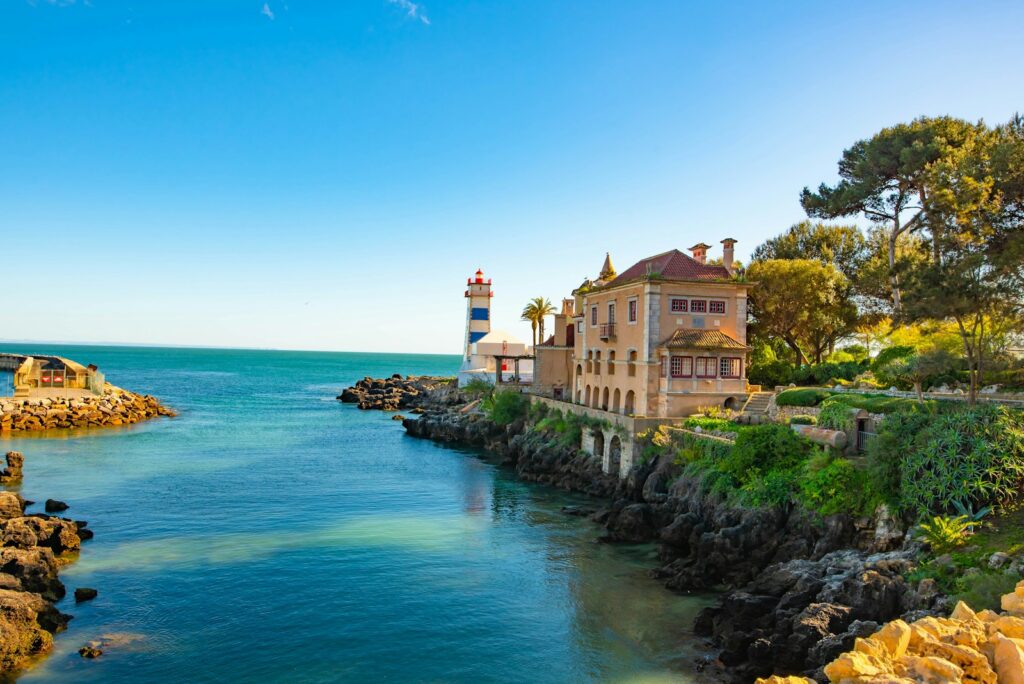
The trade-off is cost. Rents in central Lisbon have risen dramatically over the past decade, and what was an affordable capital by European standards ten years ago now competes with mid-tier cities in France or Germany for accommodation costs. Many expats who want Lisbon’s lifestyle at lower prices settle in satellite towns Cascais, Sintra, Almada, Setúbal and commute into the city on Portugal’s reasonably priced rail network.
Porto and the Douro Valley
Porto is Lisbon’s more understated sibling smaller, historically atmospheric, and significantly more affordable while still offering genuine urban sophistication. The city sits at the mouth of the Douro River, its famous port wine cellars lining the banks of Vila Nova de Gaia across the water, the historic Ribeira district climbing the steep hillsides above.
Porto has developed a real tech and creative industry scene in recent years, and its growing digital nomad community reflects that shift. Rents remain meaningfully lower than Lisbon a well-located one-bedroom apartment in Bonfim or Cedofeita costs considerably less than an equivalent flat in Lisbon’s Príncipe Real or Mouraria.
The Douro Valley hinterland wine country of extraordinary beauty offers an alternative for those willing to trade urban infrastructure for landscape. Property prices fall rapidly once you move inland from the coast, and the rural expat community here, while smaller, is tight-knit.
The Algarve
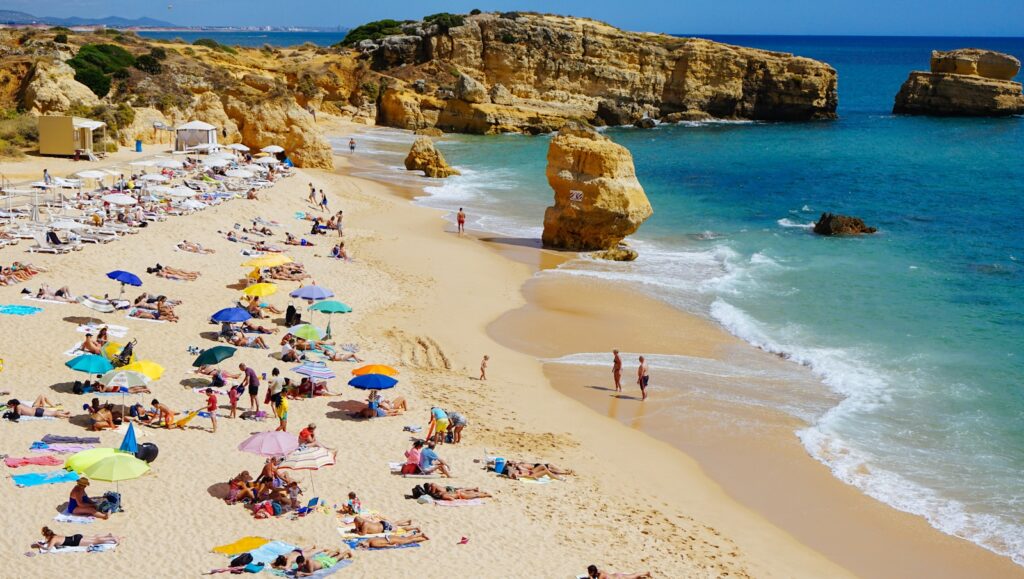
The Algarve has been the heartland of the British expat community in Portugal for decades, and that infrastructure English-speaking services, international supermarkets, private hospitals with English-speaking staff, golf courses, beach clubs reflects it. The region’s limestone cliff coastline is genuinely spectacular, and the climate in the western Algarve (the Costa Vicentina) is cooler and wilder, while the eastern Algarve around Tavira and Castro Marim is drier and increasingly popular with families seeking space and quality of life.
The Algarve is, by Portuguese standards, expensive particularly in and around Lagos, Vilamoura, and Albufeira. Seasonal tourism pushes prices up and hollows out local community life in peak summer months. Outside the tourist season, however, the Algarve’s pace of life is genuinely excellent, and the combination of beach access, relative safety, established expat infrastructure, and improving healthcare makes it the strongest retirement destination in the country for many profiles.
Central Portugal — Coimbra, Aveiro, and the Interior
Central Portugal remains considerably underexplored by the international expat community and offers some of the country’s best value. Coimbra home to one of Europe’s oldest universities, founded in 1290 is a lively, intellectually engaged city with genuine cultural depth and significantly lower housing costs than either Lisbon or Porto. Aveiro, often called the Venice of Portugal for its canal system, is charming and accessible.
The interior regions Alentejo, Beira Interior, Trás-os-Montes offer a rural Portugal of cork forests, medieval villages, and remarkable tranquillity at genuinely low cost. These areas suit those who are serious about integration rather than expat-community living, as English infrastructure is limited and Portuguese is genuinely necessary for daily life.
Madeira and the Azores
Both archipelagos have attracted growing attention from remote workers, and Madeira in particular has invested deliberately in digital nomad infrastructure. The island’s Digital Nomad Village in Ponta do Sol was one of the world’s first purpose-built digital nomad villages, and the island offers subtropical climate, dramatic volcanic landscape, and direct flights to Lisbon and multiple European cities.
The Azores nine islands in the mid-Atlantic appeal to those seeking genuine isolation and nature immersion. São Miguel, the largest island, has an otherworldly landscape of volcanic crater lakes, hot springs, and lush green hillsides. Infrastructure is developing but remains limited compared to mainland Portugal.

Portugal Visas and Residency Pathways
Portugal’s visa system offers several well-defined pathways for non-EU nationals, and understanding which one applies to your situation is the most important practical decision you will make before relocating. EU, EEA, and Swiss citizens can enter and reside freely without a visa, needing only to register with the local câmara municipal (town hall) after arrival.
For everyone else, the main visa options are managed by AIMA the Agency for Integration, Migration, and Asylum, which replaced the former SEF (Serviço de Estrangeiros e Fronteiras) in 2023.
D7 Visa — Passive Income and Retirement
The D7 is Portugal’s most popular long-stay visa for retirees and those with passive income. It requires proof of regular, stable income from outside Portugal pensions, rental income, dividends, or other passive sources sufficient to cover living costs without working in Portugal. The current minimum income threshold is approximately €820 per month for a single applicant, with additional amounts required for accompanying family members.
The D7 grants an initial two-year residence permit, renewable for successive three-year periods, and provides a pathway to permanent residency after five years and citizenship after five years of legal residency. It is the standard entry point for retirees from the United States, Canada, the United Kingdom, Australia, and other non-EU countries who have sufficient pension or passive income.
D8 Visa — Digital Nomad and Remote Work
Introduced in 2022 and refined since, the D8 visa formalises the pathway for remote workers and digital nomads who earn their income from employers or clients based outside Portugal. The income threshold is set at four times Portugal’s minimum wage currently approximately €3,280 per month for employed remote workers, with the same threshold applying to freelancers who can demonstrate equivalent ongoing income through contracts and bank statements.
The D8 requires proof of remote employment or a portfolio of freelance clients, evidence of accommodation in Portugal, comprehensive health insurance, and clean criminal background documentation. It is processed through Portuguese consulates in the applicant’s country of residence before arrival.
D2 Visa — Entrepreneur and Business Investor
The D2 is designed for entrepreneurs who intend to set up or invest in a Portuguese business. It requires a viable business plan, demonstrated financial capacity to support the venture and cover personal living costs, and for business investment evidence of the investment itself. The D2 is used by startup founders, self-employed professionals registering as sole traders (trabalhadores independentes) in Portugal, and those investing in existing Portuguese businesses.
Golden Visa — ARI (Autorização de Residência para Atividade de Investimento)
The Portuguese Golden Visa has undergone significant modifications in recent years. The 2023 changes removed real estate purchase as a qualifying investment route which was by far the most commonly used pathway leaving fund investment, capital transfer, job creation, and cultural or scientific donation as the remaining qualifying categories.
Despite these changes, the Golden Visa retains appeal for investors seeking EU residency with minimal physical presence requirements (only seven days per year in Portugal in year one, fourteen days in subsequent two-year periods). The residency pathway to citizenship after five years is a significant benefit for non-EU nationals for whom a Portuguese or EU passport carries genuine value.
More information on current Golden Visa qualifying categories is available through the official AIMA portal.
Key visa summary:
| Visa Type | Primary Applicant | Income Requirement | Key Feature |
|---|---|---|---|
| D7 | Retirees, passive income holders | ~€820/month | Stable passive income from outside Portugal |
| D8 | Remote workers, digital nomads | ~€3,280/month | Employment or freelance income from non-Portuguese sources |
| D2 | Entrepreneurs, investors | Business-dependent | Portuguese business setup or investment |
| Golden Visa (ARI) | Investors | Fund/capital qualifying investment | Minimal physical presence requirement |
Regardless of visa type, obtaining your NIF (Número de Identificação Fiscal) Portugal’s tax identification number is an urgent first step. The NIF is required for virtually every administrative transaction: opening a bank account, signing a lease, purchasing property, registering for healthcare, and filing taxes.
It can be obtained at any local Finanças office or through a Portuguese fiscal representative before arrival, which is the recommended approach. The Portuguese Tax Authority’s official portal provides the current registration framework.
The Complete Guide
Cost of Living in Portugal: Budgeting for Your Move
Portugal remains one of the more affordable countries in Western Europe, though the gap between Lisbon and Porto and cheaper interior towns is substantial and widening. The figures below reflect realistic spending for expats living comfortably without extravagance in 2026.
| Category | Lisbon / Porto (Monthly) | Algarve (Monthly) | Interior / Smaller Cities (Monthly) |
|---|---|---|---|
| Rent — 1 bed apartment | €1,200 – €1,800 | €900 – €1,500 | €450 – €800 |
| Rent — 2 bed apartment | €1,600 – €2,500 | €1,200 – €2,000 | €600 – €1,100 |
| Groceries (couple) | €300 – €450 | €280 – €420 | €220 – €350 |
| Utilities (electricity, water, gas) | €80 – €150 | €70 – €130 | €60 – €110 |
| Internet and mobile | €35 – €60 | €35 – €60 | €30 – €55 |
| Public transport (monthly pass) | €40 – €50 | Car typically needed | Car typically needed |
| Dining out (restaurant meal per person) | €12 – €25 | €14 – €28 | €8 – €18 |
| Private health insurance (individual) | €50 – €120 | €50 – €120 | €40 – €100 |
A single person living comfortably in Lisbon a good apartment in a central neighbourhood, regular restaurant meals, private health insurance, entertainment, and domestic travel can expect to spend between €2,000 and €3,000 per month.
In Porto, the equivalent lifestyle costs €1,600 to €2,500. In interior cities like Coimbra, Évora, or Viseu, €1,200 to €1,800 covers a comfortable life with meaningful savings on accommodation.
The Algarve sits between Lisbon and the interior on cost, with the premium driven by the concentration of demand from the British expat community and seasonal tourism. Property ownership in the Algarve, however, has historically held its value well, which is relevant for those considering purchasing rather than renting.
Portugal uses the Euro, which eliminates currency exchange friction for Euro-zone income holders. For those earning in dollars, pounds, or other currencies, services like Wise (formerly TransferWise) offer substantially better exchange rates than traditional bank transfers and are widely used within the expat community for regular income conversion.
Finding Housing and Negotiating a Rental or Purchase
Portugal’s rental market has tightened significantly in Lisbon and Porto over the past five years. Demand driven by tourism, short-term rental platforms, and international relocation has reduced long-term rental supply in prime urban areas, and rents in central Lisbon in particular have reached levels that surprise newcomers expecting the affordable Portugal of ten years ago.
The main property listing platforms are Idealista Portugal, Imovirtual, and ERA Portugal. For furnished short-term rentals suitable for the initial settling-in period, Uniplaces and Spotahome both have good Portuguese coverage and focus on medium-term lets.
Key points for renters:
- Standard long-term rental contracts in Portugal run for a minimum of one year, with tenant protection laws providing strong security of tenure under the Lei dos Arrendamentos Urbanos (LAU).
- The standard security deposit is one to two months’ rent, held by the landlord and returnable at the end of the tenancy subject to the condition of the property.
- Agency fees (comissão de mediação) are typically one month’s rent plus VAT (IVA at 23%), payable to the real estate agent.
- Landlords will typically require proof of income, a valid NIF, and increasingly (for foreign nationals without Portuguese credit history) a guarantor or larger deposit.
- Utility contracts electricity (EDP or Endesa), water (municipal), gas, and internet (NOS, MEO, or Vodafone Portugal) must be transferred to or opened in the tenant’s name separately from the rental contract.
For property purchasers:
Portugal welcomes foreign buyers, and the purchase process is well-established. The main stages are:
- Obtaining a NIF (essential no purchase is possible without it)
- Signing a promissory contract (Contrato de Promessa de Compra e Venda, CPCV) with a deposit of typically 10% to 30%
- Completing due diligence through a Portuguese property lawyer (advogado)
- Executing the final deed (escritura) before a notário
- Registering the transfer with the Conservatória do Registo Predial (Land Registry)
Purchase taxes include the IMT (Imposto Municipal sobre Transmissões Onerosas de Imóveis) a property transfer tax calculated on a sliding scale up to 8% depending on property value and type plus stamp duty (Imposto do Selo) at 0.8% of the purchase price, and annual IMI (Imposto Municipal sobre Imóveis) of between 0.3% and 0.45% of the property’s tax value.
Engaging an independent Portuguese property lawyer who acts exclusively for the buyer not the agent or seller before signing anything is strongly recommended.
Healthcare in Portugal: Public vs. Private
Portugal’s public healthcare system the Serviço Nacional de Saúde (SNS) provides universal access to those who qualify, and its quality, while variable by region, is generally solid for primary and emergency care. The system is funded through general taxation and social security contributions, and legal residents who are registered with the Segurança Social (social security) are entitled to register with a family doctor (médico de família) and access SNS services.
In practice, the SNS has meaningful capacity constraints. Wait times for non-urgent specialist appointments through the public system can stretch to weeks or months, and the availability of English-speaking physicians varies considerably by region it is strong in Lisbon, Porto, and the Algarve, and much more limited in rural interior areas.
For most expats, the standard approach is to maintain both SNS registration and a private health insurance policy. The SNS-24 helpline (808 24 24 24) provides a Portuguese-language telephone triage service that directs callers to appropriate care.
The main private healthcare providers serving the expat community in Portugal include:
- CUF — the largest private hospital network in Portugal, with facilities in Lisbon, Porto, and the Algarve. Generally considered the gold standard for private care. cuf.pt
- Lusíadas Saúde — another major private network with hospitals and clinics across the country. lusiadasaude.pt
- HPA Health Group — the principal private hospital group in the Algarve, with English-speaking staff and a strong reputation among the expat community.
Private health insurance policies from providers including Médis, Multicare, and AdvanceCare or international expat health insurance from providers like Cigna Global or AXA International typically cost between €50 and €150 per month for an individual in their 40s, rising with age.
For arrivals on the D7 or D8 visa, comprehensive health insurance covering Portugal is a mandatory visa requirement, so this cost is built into the relocation from day one.
Emergency care including ambulance (INEM, the national emergency medical service) and hospital emergency departments is available regardless of insurance status, with costs charged to uninsured patients at regulated rates.
The Complete Guide
Taxes and Banking for Expats in Portugal
This is the area that has undergone the most significant change in recent years, and it is the one where professional advice from a qualified Portuguese tax advisor or international tax consultant is most important before you finalise your relocation plans.
The NHR Regime and Its 2024 Replacement
The Non-Habitual Resident (NHR) tax regime was, for a decade, one of the most powerful tools in the expat relocation toolkit. It offered qualifying new residents a flat 20% income tax rate on Portuguese-source income from high-value activities, and critically a 10-year exemption from Portuguese tax on most foreign-source income including pensions, rental income, dividends, and capital gains, provided the income was subject to tax in the country of origin.
The original NHR regime closed to new applicants at the end of 2023. A replacement scheme the IFICI regime (Incentivo Fiscal à Investigação Científica e Inovação), informally called NHR 2.0 was introduced in 2024 and targets a narrower category of qualifying applicants: researchers, scientists, technology and innovation professionals, faculty at Portuguese higher education institutions, and qualified professionals in investment funds and technology companies. If your professional profile fits within these categories, IFICI provides similar flat-rate tax benefits.
For those who do not qualify for IFICI, standard Portuguese income tax applies on a progressive scale, with rates rising from 13.25% to 48% depending on income level, plus a solidarity surtax on higher incomes. Portugal does not levy a wealth tax.
Portugal has double taxation agreements with most major expat-origin countries including the United States, the United Kingdom, Canada, and Australia meaning that income already taxed in your home country is not subject to double Portuguese taxation, though the interaction between systems is nuanced and professional advice is essential. The Portuguese Tax Authority (Autoridade Tributária e Aduaneira) maintains the official list of current double taxation treaties.
Banking
Opening a Portuguese bank account is straightforward for legal residents with a NIF. The major banks serving the expat community include:
- Millennium BCP — largest private bank in Portugal, with good English-language service in urban branches
- Caixa Geral de Depósitos — the state-owned bank, with the widest branch network
- Novo Banco — strong private bank with good service in expat areas
- Santander Portugal — useful for those with existing Santander relationships internationally
Online and fintech alternatives Revolut (EU-licensed), N26, and Wise’s borderless account are used widely within the expat community for daily spending, international transfers, and currency conversion. Portugal is part of the SEPA payment area, meaning euro transfers to and from other European accounts are fast, cheap, and reliable.
Education and Family Life in Portugal
For families relocating to Portugal, the education question is typically the most significant factor after housing and healthcare. Portugal’s public school system provides free education from pre-school (jardim de infância) through to secondary completion, delivered in Portuguese. Academic standards in Portuguese public schools are reasonable, and the system has improved significantly in international assessments over the past decade.
For children who arrive without Portuguese, the transition into public schooling requires support. Portuguese law mandates Portuguese language support (Português como Língua Não Materna) for foreign children, though the quality and availability of this provision varies by school and municipality.
The international and bilingual private school sector in Portugal is well-developed, particularly in Lisbon, Porto, and the Algarve:
- St. Julian’s School (Carcavelos, near Lisbon) — one of the oldest and most respected British curriculum schools in Portugal
- Carlucci American International School of Lisbon — US curriculum, IB programme
- The British School of Lisbon — British National Curriculum
- OAK International School (Porto) — bilingual Portuguese-English curriculum
- Nobel International School (Algarve) — British curriculum serving the expat community
Annual fees at established international schools range from approximately €10,000 to €25,000 per child depending on age, school, and curriculum. Bilingual Portuguese private schools (colégios bilingues) offer a lower-cost alternative with strong English alongside the Portuguese curriculum, at fees of approximately €4,000 to €10,000 per year.
Portugal’s university system anchored by the University of Lisbon, the University of Porto, and the University of Coimbra (one of the oldest continuously operating universities in the world) is internationally respected and participates fully in the Erasmus programme. Tuition fees for EU students are among the lowest in Western Europe.
Day-to-Day Life: Language, Culture, and Integration
The single most important thing prospective expats underestimate about life in Portugal is the language. English proficiency is high in Lisbon, Porto, and tourist-facing areas particularly among people under 40 but it drops off sharply in rural and interior regions. More importantly, even in areas where English is available as a fallback, operating exclusively in English creates a ceiling on integration that limits professional opportunities, social relationships, and the depth of cultural engagement.
Portuguese is not an easy language for English speakers, but it is a rewarding one. The basic structure is accessible verb conjugations are more complex than Spanish, and the phonology takes adjustment, but functional conversational Portuguese is achievable within six to twelve months of consistent study.
Recommended Portuguese language learning resources:
- CIAL Centro de Línguas — one of the leading Portuguese language schools in Lisbon, offering group and private instruction
- The Camões Institute — the official Portuguese cultural and language institute, with information on recognised language courses
- Apps including Pimsleur (particularly strong for Portuguese phonology), Duolingo, and Babbel for daily practice
- Language exchange meetups — widely available in Lisbon and Porto through Meetup.com and local community boards
Culturally, Portugal is a country of understated warmth. The concept of saudade an untranslatable Portuguese word describing a bittersweet longing for things past or absent captures something essential about the national character: a tendency toward reflective melancholy that coexists with genuine friendliness and generosity toward visitors and newcomers.
Family ties are strong, dinners are late (rarely before 8pm, often after 9pm), and the café culture long, slow coffees (a bica in Lisbon, a cimbalino in Porto) at neighbourhood cafés is an important part of daily social rhythm.
Public holidays and local festivals punctuate the calendar throughout the year. June is particularly festive the Santos Populares celebrations in Lisbon (Festa de Santo António on June 13th) and Porto (Festa de São João on June 23rd and 24th) transform both cities with outdoor grilling, sardines, street dancing, and neighbourhood festivals that run through the night. Participating in these events, rather than observing them from a distance, is the most direct available route into genuine local community life.
Transport and Getting Around Portugal
Portugal’s transport infrastructure is functional, improving, and most effective in and between Lisbon and Porto. Outside the major urban centres, a car becomes increasingly necessary.
Public transport in Lisbon is operated by a combination of Metro Lisboa (four lines covering most of the city), Carris (buses and historic trams), and the Fertagus and CP (Comboios de Portugal) suburban rail lines connecting outer districts and satellite towns.
The Navegante monthly pass covers unlimited travel across all public transport modes in the Lisbon metropolitan area for approximately €40 per month exceptional value for regular users. Lisbon’s historic trams (particularly Tram 28 through Alfama) are charming but slow; the metro is far more practical for daily commuting.
Public transport in Porto combines the Metro do Porto (six lines), STCP buses, and suburban rail. The Andante rechargeable card covers all modes and is the standard payment method for regular users.
Intercity rail is operated by CP — Comboios de Portugal, with the Alfa Pendular high-speed service connecting Lisbon and Porto in approximately three hours and serving intermediate cities including Coimbra and Aveiro. Tickets booked in advance online are significantly cheaper than walk-up fares.
Driving in Portugal is on the right, with a maximum speed limit of 120km/h on motorways (autoestradas). Portugal’s motorway network is extensive and generally well-maintained, though tolls apply to most major routes through an electronic system (Via Verde) that requires a transponder or pre-registration.
Non-EU driving licences must be exchanged for a Portuguese licence within 90 days of establishing residency the process is managed through the IMT (Instituto da Mobilidade e dos Transportes). The IMT official portal provides current requirements.
In the Algarve and rural interior regions, a car is effectively essential. Public bus services exist but are infrequent and poorly timed for practical daily use. Car ownership costs in Portugal include annual road tax (IUC), mandatory basic insurance (seguro automóvel), and toll costs which can be meaningful for regular highway users.
Safety, Bureaucracy, and Common Pitfalls
Safety
Portugal’s safety record is one of its most consistent selling points and one of the primary reasons it has attracted so many families and retirees. It ranks consistently in the top ten globally in the Global Peace Index, with violent crime rates among the lowest in Europe.
Petty theft pickpocketing and bag-snatching in tourist-heavy areas of Lisbon (particularly on the historic Tram 28 route and in Alfama) and in Algarve beach resorts is the most commonly reported issue for expats, and the standard urban awareness precautions address it effectively.
Bureaucracy
Portugal’s bureaucratic system is the aspect of relocation that generates the most frustration among newcomers, and it is worth going in with realistic expectations rather than being blindsided later. Appointments at AIMA (the immigration authority) can take weeks or months to obtain. Document processing times are slow. Communication from government offices can be inconsistent. Paperwork submitted with even minor errors is typically returned for correction rather than queried proactively.
The practical solution that the experienced expat community consistently recommends is engaging a Portuguese advogado (lawyer) or relocation agent who knows the system, has established relationships with the relevant offices, and can navigate the administrative process on your behalf.
The cost typically €500 to €2,000 for immigration document management is money well spent compared to the time and stress of managing the process independently in a language you may not yet speak.
Common Pitfalls to Avoid
- Not getting your NIF before arrival or immediately on arrival. Everything else bank accounts, rental contracts, healthcare registration, tax filing depends on it.
- Underestimating upfront housing costs. First month’s rent, last month’s rent, security deposit, and agency fees can total four to five months’ rent before you move in.
- Assuming English is universally available. It is not, particularly in government offices, healthcare settings outside major cities, and rural areas.
- Not arranging health insurance before visa application. Comprehensive health insurance is a mandatory requirement for D7 and D8 visa applications and cannot be arranged retrospectively.
- Assuming the NHR tax regime applies to your situation. The original NHR is closed. Verify current eligibility for IFICI with a qualified Portuguese tax advisor before making financial plans that depend on preferential tax treatment.
- Moving without a financial buffer. The combination of slow document processing, difficulty accessing banking without established residency documentation, and upfront housing costs means that a buffer of three to six months of living expenses is genuinely necessary.
Checklist: Step-by-Step Before You Move to Portugal
Six to three months before departure:
- Determine your visa category (D7, D8, D2, or Golden Visa) based on your income profile and circumstances
- Begin gathering and apostilling required documents: birth certificates, marriage certificates, criminal background checks, proof of income, and health insurance documentation
- Apply for your NIF through the Portuguese consulate in your home country or via a Portuguese fiscal representative this can and should be done before you arrive
- Research regions and cities based on lifestyle priorities, budget, and proximity to required infrastructure (schools, healthcare, airports)
- Begin Portuguese language study the earlier the better
- Obtain health insurance that meets Portuguese visa requirements
- Start the visa application process through your local Portuguese consulate allow three to six months for processing
Three to one month before departure:
- Arrange temporary accommodation for the first one to three months furnished short-term rentals are the standard approach while you search for a longer-term home
- Research schools if relocating with children and begin inquiry processes early popular international schools have waiting lists
- Arrange international shipping or freight for belongings if applicable
- Notify your home country bank of your move and confirm your ability to access funds internationally while Portuguese banking is established
- Book a consultation with a Portuguese tax advisor to understand your current obligations and any available regime benefits
Arrival week:
- Register at the local câmara municipal (town hall) for empadronamento (address registration) this is the first administrative step and triggers access to multiple services
- Open a Portuguese bank account as soon as your NIF is confirmed
- Book your AIMA appointment for TIE/residence permit processing
- Register with the Segurança Social
- Register with a local SNS health centre (centro de saúde) for public healthcare access
- Begin the longer-term housing search in your chosen area
The Complete Guide
Conclusion — Is Moving to Portugal Right for You in 2026?
Portugal in 2026 is a different proposition from Portugal in 2016, and understanding that evolution is part of making an informed decision. The country is more expensive than it was particularly in Lisbon and Porto the original NHR tax advantage is no longer available to most new arrivals, and the administrative process for residency has become more contested by volume of applications even as AIMA has worked to improve processing capacity.
And yet the fundamental case for Portugal remains compelling. The climate is genuinely excellent across most of the country for most of the year. The safety record is outstanding. The food and wine culture is world-class. The expat community is mature, helpful, and geographically dispersed enough to suit multiple lifestyle preferences.
EU and Schengen membership provides stability and freedom of movement that other affordable relocation destinations cannot match. And the Portuguese people patient, hospitable, quietly proud make the process of integration rewarding for those who approach it with respect and genuine curiosity.
The expats who thrive in Portugal are those who arrive with realistic expectations, adequate financial preparation, a willingness to engage with the language and the bureaucracy on the country’s own terms, and enough patience to let the slower rhythms of Portuguese life reveal their considerable rewards.
For those who make that commitment, Portugal delivers something that is genuinely difficult to find elsewhere: a life that is both affordable and rich, in a country that has been refining the art of civilised living for the better part of a millennium.