Moving to San Marino in 2026: The Complete Expat Guide to Residency, Cost of Living, and Daily Life
There are countries that attract expats loudly through marketing campaigns, digital nomad visa press releases, and social media content from influencers who arrived last month. And then there is San Marino, which has been quietly doing something rather extraordinary for centuries without particularly trying to tell anyone about it.
The Republic of San Marino is the world’s oldest surviving republic, founded according to tradition in 301 AD, and the world’s smallest republic by population with around 33,000 inhabitants. It sits entirely within Italian territory, perched atop Mount Titano in the Apennine Mountains between the Emilia-Romagna and Marche regions, roughly 15 kilometres from the Adriatic coast and 25 kilometres from Rimini.
It is not a member of the European Union, though it has a customs union with the EU and uses the Euro. It is not part of the Schengen Area, though it operates within the Italian border framework such that entering Italy and entering San Marino are, in practice, the same movement.
What makes San Marino interesting for internationally mobile people in 2026 is a specific combination: a preferential tax regime for foreign residents who generate income abroad, a cost of living that is meaningfully lower than equivalent-quality locations in northern Italy or other Mediterranean alternatives, an extraordinary quality-of-life environment in medieval-fortress surroundings, and proximity to Italian infrastructure that effectively gives residents access to a major European country without the full weight of Italian bureaucracy or Italian tax rates.
This guide is for people who are seriously considering San Marino as a residential base not as an abstract curiosity, but as a practical destination for expats, retirees, and remote professionals who want something genuinely different from the standard Mediterranean relocation script.
Why San Marino Appeals to Expats and Retirees
The appeal of San Marino resolves into several distinct dimensions, and different profiles of relocator will weight them differently.
The tax position is one of the cleaner and more underappreciated in Europe. The Atypical Residency regime specifically designed for foreign residents who generate all of their income from outside San Marino exempts qualifying residents from Sammarinese income tax on that foreign-sourced income for the first decade of residence.
San Marino’s personal income tax rates are progressive, generally ranging from around 9 to 35 percent, but residents on the Atypical Residency programme who earn exclusively from abroad can benefit from a preferential flat-rate arrangement that significantly reduces their effective tax burden.
The corporate tax rate of 17 percent is competitive by European standards, and the country imposes no wealth tax and no inheritance tax between direct family members.
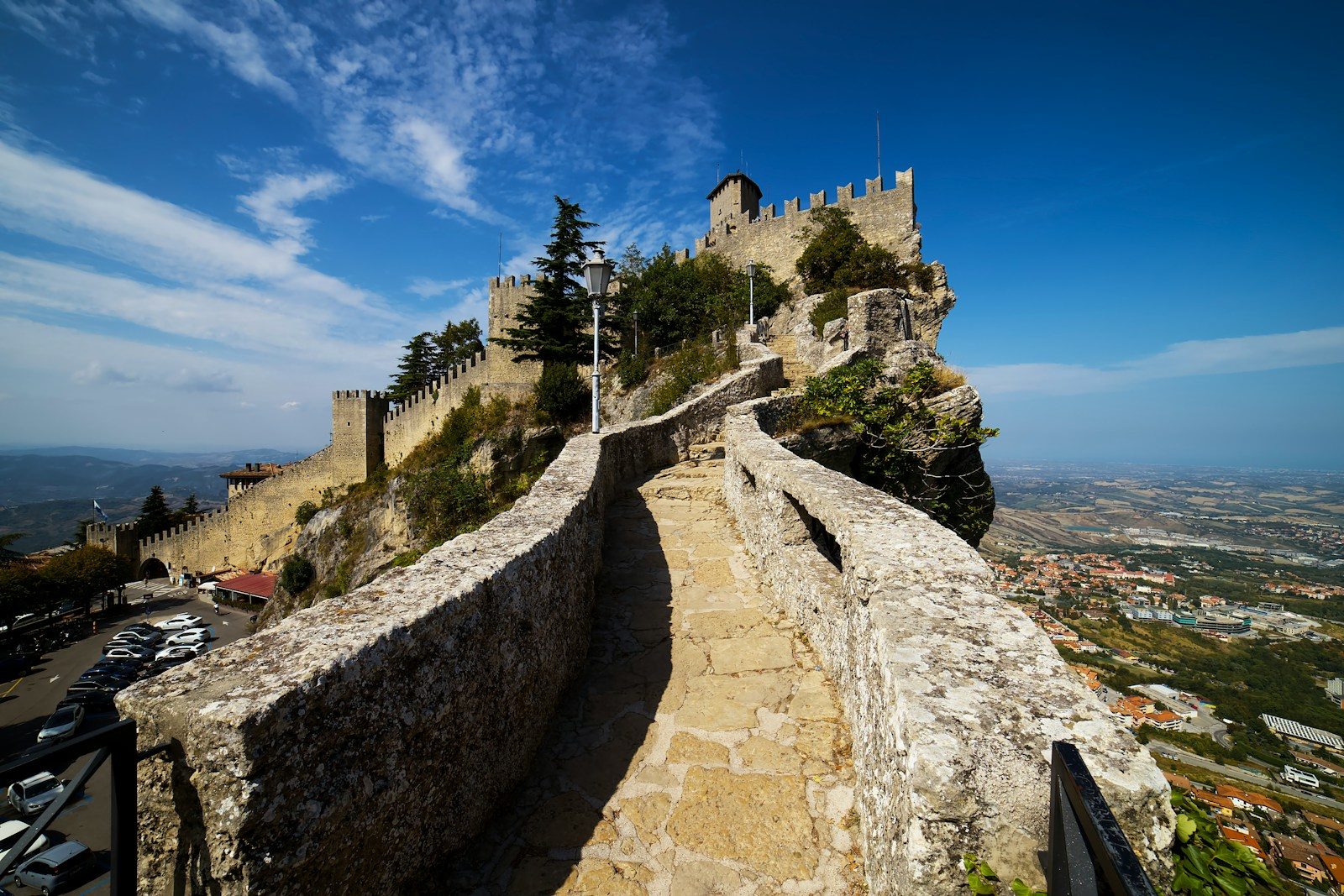
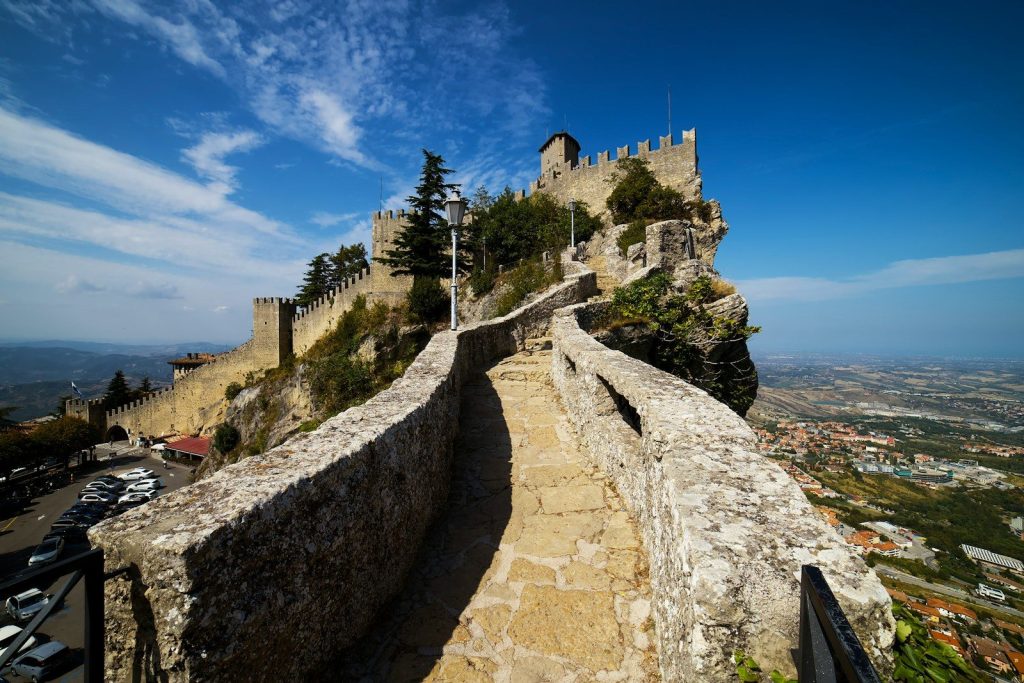
The physical environment is extraordinary in a way that photographs convey but do not fully capture. The historic capital Città di San Marino sits at 739 metres above sea level on the crest of Mount Titano, with its three medieval towers (the Guaita, the Cesta, and the Montale) visible from across the surrounding plains.
The UNESCO World Heritage designation covers both the historic centre and Mount Titano, and the combination of Romanesque architecture, defensive walls, and panoramic views over northeastern Italy creates a residential setting that is genuinely unlike any other inhabited place in Europe.
Safety is near-absolute by any measurable standard. San Marino’s crime statistics are among the lowest of any populated territory in the world, and the sense of personal security walking at any hour, leaving belongings unattended, moving freely through the streets is one of the most immediately striking features of life there for newcomers arriving from larger cities.
The population’s compactness contributes to this: in a republic of 33,000 people spread across nine municipalities (castelli), anonymity is not a feature of daily life in the way it is in major cities.
Proximity to Italy without full immersion in Italian bureaucracy is a specific and genuine advantage for many expats. San Marino residents have immediate access to Rimini 25 minutes by car which provides a full range of Italian urban services: shopping, hospitals, universities, transport connections including Rimini Miramare Airport and the main Adriatic coast rail line, and cultural life. Italian healthcare facilities are accessible.
Italian international schools serve families with children. But the administrative framework within which residents operate is Sammarinese rather than Italian, which means the Italian bureaucracy’s well-documented complexities around tax registration, Codice Fiscale management, and administrative permitting are not the daily reality of San Marino residents.
Residency Eligibility: Who Can Move Here?
San Marino’s residency framework is distinct from EU member state immigration systems and requires careful understanding before beginning any process.
EU, EEA, and Swiss citizens have a simplified pathway San Marino’s Friendship, Good Neighbourliness and Cooperation Treaty with the EU creates relatively straightforward registration procedures for EU nationals, analogous in spirit to how EU citizens move within the bloc, though the specific administrative steps differ from standard EU free movement processes.
Non-EU nationals including British nationals post-Brexit, Americans, Australians, Canadians, and citizens of most non-European countries must approach San Marino residency through one of the structured permit pathways, and must first enter via Italy (which may require a Schengen or Italian long-stay visa depending on nationality). The practical entry point is the Italian consulate in the applicant’s country of residence, where a long-stay visa appropriate for the intended San Marino activity is obtained before travel.
San Marino provides two main categories of legal status for foreign residents who intend to stay for more than 30 days: a temporary stay permit (valid from 3 months to a maximum of 12 months, renewable) and full residency for long-term stays. The relevant Sammarinese authority for residency matters is the Secretariat of State for Foreign Affairs, accessible through its official portal at esteri.sm.
The main residency categories are:
Elective Residency is for foreign citizens who establish their residence in San Marino through qualifying real estate or financial investments. It carries some limitations most notably, holders cannot be employed in the Expanded Public Sector and converts to full registered residency after 10 years. The investment threshold for property purchase qualifying for this route is generally in the range of €350,000 to €500,000.
Atypical Residency (Residenza Atipica) is the most relevant route for digital nomads, remote workers, entrepreneurs, and investors who generate all of their income from outside San Marino. This route is specifically designed for foreign citizens who have never previously been residents in San Marino and who can demonstrate that their income is entirely foreign-sourced.
It offers a preferential tax treatment effectively exempting foreign-sourced income from Sammarinese income tax for the initial period of residence and converts to full registered residency after 10 years. The minimum annual passive income requirement for this route is typically cited at approximately €25,000 to ensure financial self-sufficiency.
Atypical Residency for Pensioners is a variant specifically available to EU citizens, Swiss nationals, and citizens of other countries with bilateral agreements, who receive pension income from abroad and wish to establish San Marino as their primary residence.
Regular Residency covers family reunification with Sammarinese citizens, establishment of business activities in San Marino, and management positions in Sammarinese companies or institutions. This is the route for those who intend to work within the Sammarinese economy.
Standard Temporary Stay Permit is the entry-level document for those arriving on a visitor or study basis, valid for up to 12 months and renewable while longer-term residency applications are processed.
One significant practical note: San Marino citizenship by naturalisation requires 30 years of continuous residency and the renunciation of any other citizenship one of the longest naturalisation pathways in the world. However, a 15-year pathway exists through marriage to a Sammarinese citizen, and citizenship by descent routes exist for those with documented Sammarinese ancestry.

The Complete Guide
How to Apply for San Marino Residency: Step by Step
The process is structured and sequential, and getting the sequence right avoids delays.
Step one: Enter via Italy. Non-EU nationals must obtain the appropriate Italian long-stay visa from their home country’s Italian consulate before travelling. San Marino does not issue its own entry visas; the Italian border framework governs entry. EU nationals can enter directly without visa requirements.
Step two: Secure accommodation. A signed lease or property purchase agreement is required for the residency application. Accommodation must be appropriate a studio or one-bedroom apartment meeting minimum size standards is typically sufficient for a single applicant. The rental agreement must be for a minimum of 12 months.
Step three: Gather documentation. Standard requirements include a valid passport (with minimum six months’ validity), proof of income or financial resources appropriate to the residency category, valid health insurance (private, covering all medical costs in San Marino and Italy), a clean criminal record certificate (apostilled from the issuing country), proof of accommodation, and the specific application forms for the residency category being applied for.
Step four: Submit to the Sammarinese authorities. Applications are submitted to the Gendarmerie’s Foreign Office (Ufficio Stranieri della Gendarmeria) in Città di San Marino, which handles residency permits and stay authorisations. The Secretariat of State for Foreign Affairs oversees the broader residency framework. Processing typically takes one to three months for standard applications.
Step five: Register at the Anagrafe. Following approval, the applicant registers at the civil registry (Anagrafe) to obtain the Sammarinese identity card (Carta di Identità Sammarinese) and tax identification code. This registration is the formal trigger for tax residency and healthcare enrolment.
Best Places to Live in San Marino
San Marino is divided into nine municipalities (castelli), each with distinct characteristics. The country is small enough that physical distance between them is measured in minutes, but the lifestyle and cost differences are meaningful.
| Municipality | Avg 1-Bed Rent | Best For | Drive to Italy |
|---|---|---|---|
| Città di San Marino (Capital) | €600 – €900 | History, culture, tourism | 20 minutes to Rimini |
| Borgo Maggiore | €500 – €800 | Families, residential, cable car access | 15 minutes |
| Serravalle | €400 – €700 | Value, commerce, shopping, proximity to Italy | 10 minutes |
| Domagnano & Faetano | €350 – €600 | Rural quiet, vineyards, lower costs | 15–20 minutes |
| Fiorentino & Acquaviva | €400 – €650 | Modern residential, practical living | 12 minutes |
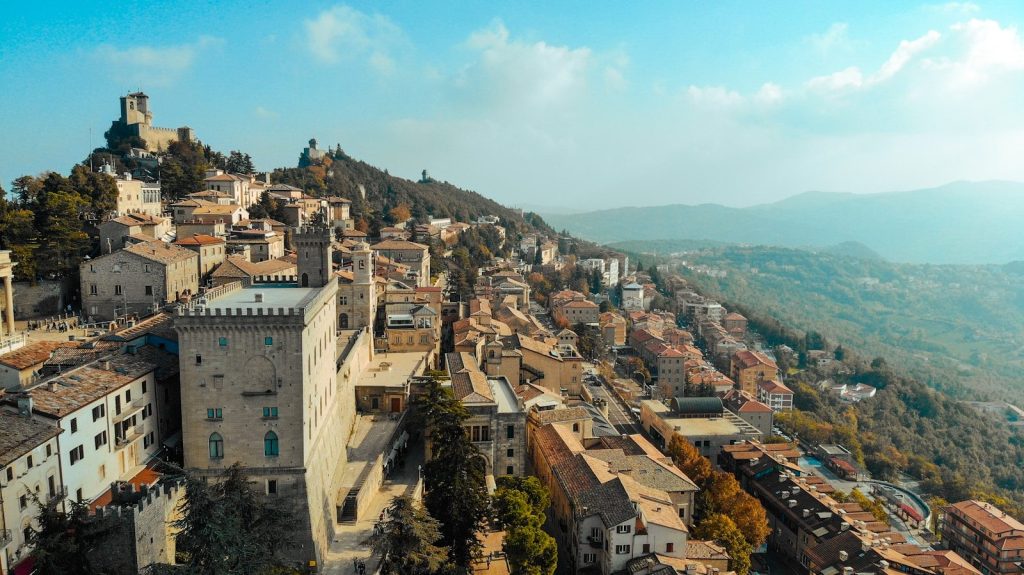
Città di San Marino universally referred to simply as the Città or the capital is the historic heart of the republic, built along the three ridges of Mount Titano within its medieval defensive walls. The streets are pedestrianised, lined with stone buildings, and in summer heavily visited by tourists who come specifically for the Three Towers and the UNESCO heritage landscape.
Living in the Città means living inside one of Europe’s most dramatically situated historic settlements, with views extending on clear days to the Adriatic and, in the other direction, toward the Apennine ridgeline.
The practical trade-off is the seasonal tourism dynamic: in summer, the historic centre is genuinely crowded during the day, and the resident experience during peak season requires adjustment. In the quieter months October through April the Città reverts to a community feel of striking intimacy.
Borgo Maggiore is the commercial and administrative centre immediately below the historic capital, connected to it by the Funivia San Marino the cable car that serves as both a practical transport link and one of the more unusual commuting options available to any working population in Europe.
Borgo Maggiore has a permanent market, the main bus station, and a residential character that is considerably more low-key than the tourist-facing Città above. For families with children and residents who want proximity to the capital’s services without the tourist density, it offers the best combination.
Serravalle is the republic’s most commercially active municipality and the one closest to the Italian border. The commercial district along the Via San Marino contains supermarkets, retail outlets, car dealers, and the everyday commerce of a functioning small town. Rents in Serravalle are the most affordable in the republic for equivalent property size, and the proximity to the Italian road network the A14 Adriatic motorway is accessible within 15 minutes makes it practical for residents who travel frequently to Italy.
Domagnano, Faetano, and Acquaviva are the rural municipalities of San Marino’s eastern flank small, quiet, and agricultural in character, with stone farmhouses, vineyards producing the Brugneto and Tessano wine varieties, and a pace of daily life that is several registers quieter than even the residential areas of Borgo Maggiore. For retirees and remote workers who genuinely want rural European quiet without total geographic isolation, these areas offer very affordable housing and the complete absence of tourist crowds.
Cost of Living in San Marino: A Realistic Budget
San Marino is more affordable than the major northern Italian cities Milan, Bologna, Florence and comparable to smaller Italian provincial towns, with the specific advantage of lower rental costs relative to quality than most of its immediate Italian neighbours.
The overall cost of living in San Marino is approximately 20 to 30 percent lower than in larger European cities. For a single professional, a comfortable monthly budget including rent ranges from approximately €1,400 to €2,100 depending on the municipality and lifestyle.
For a couple or small family, €2,500 to €4,000 per month covers a comfortable standard of living, including rent, private schooling options nearby in Rimini or Italian state schools, and regular cross-border Italian shopping for variety.
| Expense Category | Serravalle / Rural | Borgo Maggiore | Città di San Marino |
|---|---|---|---|
| Rent (1-bed apartment) | €400 – €700 | €500 – €800 | €600 – €900 |
| Utilities (electricity, water, internet) | €80 – €130 | €90 – €140 | €100 – €160 |
| Groceries (single person) | €250 – €350 | €270 – €370 | €280 – €380 |
| Transport (car or bus) | €100 – €200 | €80 – €150 | €50 – €100 |
| Dining out (moderate) | €150 – €280 | €150 – €300 | €200 – €350 |
| Health insurance (private, if required) | €70 – €120 | €70 – €120 | €70 – €120 |
| Approximate Monthly Total | €1,050 – €1,780 | €1,160 – €1,880 | €1,300 – €2,010 |
Several specific points deserve attention. San Marino levies no VAT on many basic goods the republic has its own tax system that historically has not applied full EU VAT rates across all categories, which is one reason why the duty-free and tax-free shopping that the country has been known for continues to attract Italian day-trippers.
This affects grocery prices meaningfully, and the Sammarinese market for certain goods fuel, tobacco, and electronics in particular is noticeably cheaper than equivalent Italian prices. Internet connectivity is reliable, with average speeds around 100 Mbps and fibre-to-home available in most residential areas at €25 to €40 per month. The republic has one of the highest internet penetration rates in the world for its population size.
The Adriatic coast, 15 minutes by car, extends the effective living environment considerably. Rimini’s beaches, restaurants, railway connections, and Italian supermarkets all function as de facto extensions of San Marino life. Many residents do a significant portion of their grocery shopping in Rimini, where the broader Italian retail market provides variety and competition that the small domestic market cannot.
The Complete Guide
Housing: Renting vs Buying Property
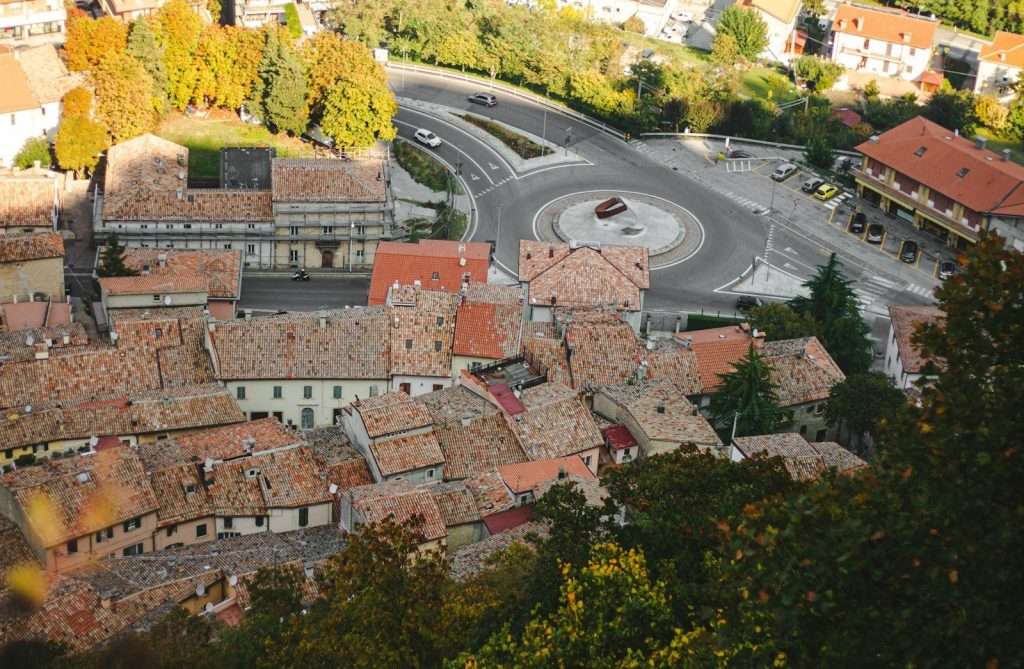
The rental market in San Marino operates at a relatively small scale the total residential population is around 33,000 people which means that the number of properties available at any given moment is limited compared to a city of equivalent importance. The main residential areas with the most rental availability are Serravalle, Borgo Maggiore, and the residential streets below and around the Città.
Standard lease terms are typically one year, with renewals available. Deposits run two to three months of rent. Agency fees are charged at varying rates it is worth engaging a local estate agent who works specifically within the San Marino market, as the national portals are small and relationships with landlords matter in a community this compact.
The main local real estate agency network includes operations affiliated with the Castelli di San Marino advisory platform, which provides both residency guidance and property services for international clients.
For property purchase, foreigners who hold a valid San Marino residence permit can buy freely. The Investor Residency route requires a minimum property investment of approximately €500,000, or €350,000 where significant renovation works are included. Property transfer taxes and notarial fees in San Marino are generally comparable to Italian equivalents.
Properties in the historic centre carry premiums reflecting both the UNESCO heritage classification and the limited supply; properties in Serravalle and the rural castelli offer meaningfully better value per square metre.
One important practical note for property buyers: San Marino has its own land registry and property registration system, separate from Italy’s. All property transactions must go through a Sammarinese notary (Notaio Sammarinese), and title searches are conducted through the Ufficio del Registro.
Given the specialist nature of this process, using a locally qualified property lawyer is strongly recommended rather than relying on advisors familiar only with Italian property law.
Taxes and Financial Perks for New Residents
San Marino’s tax framework is the element of residency that requires most careful pre-move planning, and it rewards those who engage specialist advice before arriving.
The standard personal income tax (Imposta Generale sui Redditi IGR) is progressive: rates begin at approximately 9 percent at the lower end of the scale and rise to 35 percent at the highest bracket, applied on taxable Sammarinese income. For residents who earn locally, this is the applicable framework.
For residents under the Atypical Residency regime, the position is fundamentally different. Foreign-sourced income income generated entirely outside San Marino is covered by a preferential flat-rate arrangement that effectively reduces or eliminates the IGR liability on that income for the duration of the atypical residency period (up to 10 years, after which the resident transitions to full registered residency status).
This is what makes San Marino compelling for remote workers, investors living on dividends, and retirees with foreign pension income. The exact rate and structure of the preferential treatment should be confirmed with a Sammarinese tax professional (commercialista sammarinese) before applications are submitted, as the specifics can vary based on individual circumstances and any applicable bilateral agreements.
San Marino imposes no wealth tax and no inheritance tax between direct family members. Corporate tax is levied at 17 percent, which is competitive within the European context well below Italy’s standard corporate rate and comparable to the more attractive EU member state rates like Cyprus’s 12.5 percent and Ireland’s 12.5 percent.
San Marino has concluded a Tax Information Exchange Agreement with Italy and cooperates with OECD international transparency standards. The republic participates in the Common Reporting Standard (CRS) for automatic exchange of financial information.
This context matters for people considering San Marino as part of a tax planning strategy: the jurisdiction is compliant and transparent, not opaque, and professional advice from a specialist familiar with both San Marino’s framework and the applicant’s home country tax obligations is essential.
For banking, San Marino has its own banking sector separate from Italy’s. The main domestic institution is Banca Agricola Commerciale (BAC), along with Cassa di Risparmio della Repubblica di San Marino and smaller institutions. Accounts are opened post-residency establishment, with passport, tax code, and proof of address as the standard requirements.
The Agenzia Monetaria di San Marino, the republic’s monetary authority, regulates the financial sector and maintains information on financial services at asmtel.sm. SEPA transfers within the eurozone work normally. International transfer platforms including Wise and Revolut are used by the expat community for cross-border financial management.
Healthcare and Insurance
San Marino operates its own national health service through the Istituto per la Sicurezza Sociale (ISS) the Institute for Social Security which provides comprehensive healthcare to all registered residents. The ISS manages the Ospedale di Stato (State Hospital), located in Borgo Maggiore, which serves as the primary inpatient facility for the republic.
The hospital handles general medicine, surgery, and most specialist consultations. For highly complex cases or procedures requiring specialist equipment, the proximity to Italian hospitals Rimini, Cesena, and Bologna are all within accessible driving range means that residents effectively have access to Italy’s broader healthcare infrastructure.
EU citizens arriving in San Marino prior to formal residency registration can use their European Health Insurance Card (EHIC) for emergency and necessary treatment, as the ISS cooperates with the EU healthcare framework. Once formally registered as residents, legal residents of San Marino are enrolled in the ISS system through social security contributions, which provide access to the full range of public healthcare services.
Applicants for residency permits must hold a valid private health insurance policy before the application is accepted. This is a firm requirement, not a recommendation the ISS enrolment that comes with formal residency registration does not cover the pre-registration period.
International providers including Cigna Global and AXA International both offer policies covering San Marino and Italy. Annual premiums for a comprehensive policy for a healthy adult in their thirties or forties typically run €800 to €1,500.
Dental care and optical services are available through both the public ISS network and private practitioners. Costs are generally comparable to Italian private rates, and many residents also use Italian practitioners in Rimini for specific services.
The accessibility of Italian healthcare within a 20-minute drive is a meaningful practical advantage that effectively extends the healthcare options available to San Marino residents well beyond what a country of 33,000 people would typically offer.
The Complete Guide
Banking, Work, and Business Setup
Opening a Sammarinese bank account is the first financial step after residency is established, and the process is standard by European banking norms. The main institutions Banca Agricola Commerciale and Cassa di Risparmio della Repubblica di San Marino require the applicant’s Sammarinese identity card or valid residence document, the Sammarinese tax code obtained through Anagrafe registration, proof of address, and, for accounts of any size, source of funds documentation appropriate to the applicant’s financial profile.
San Marino’s banking system operates under Sammarinese financial regulation rather than Italian or EU prudential frameworks, though it maintains alignment with major international standards including FATF anti-money laundering requirements and CRS reporting. This regulatory independence is both a feature (the system is its own entity, not subject to Italian banking disruptions) and a consideration (deposits are not covered by EU deposit guarantee schemes).
Most international expats also maintain accounts at Italian banks either in Rimini or through online Italian banks for everyday Italian transactions and access to the SEPA payment network.
The Sammarinese labour market is small and primarily local in orientation. The main employment sectors are manufacturing (particularly precision mechanics, ceramics, and clothing), tourism, financial services, and public administration.
For non-EU nationals on Atypical Residency permits, local employment is not permitted the permit is explicitly structured for those who earn from abroad. EU nationals who move to San Marino through regular residency pathways have access to the labour market, though the practical scope is limited by the economy’s small size.
For entrepreneurs and business founders, San Marino offers a genuine alternative to Italian company formation. The standard Sammarinese company structure the Società Semplice or the Società a Responsabilità Limitata (SRL equivalent) can be registered with minimum share capital requirements through the Ufficio di Stato Competente per il Registro delle Imprese.
The 17 percent corporate tax rate, combined with the Atypical Residency’s favourable personal income treatment, creates a potentially attractive structure for internationally oriented businesses whose clients and revenues are outside San Marino.
Remote workers and digital nomads who do not intend to engage the local labour market operate outside the employment framework their work is performed for foreign principals, invoiced from whatever structure suits their specific situation, and the Atypical Residency framework simply requires that this income is entirely sourced from outside San Marino.
Daily Life: Education, Transport, and Leisure
The practical quality of daily life in San Marino is shaped substantially by the country’s relationship with Italy, and residents who approach this relationship pragmatically using Italy for services, shopping, and transport that the domestic market cannot efficiently provide tend to find the arrangement genuinely comfortable.
San Marino has its own state school system, providing education in Italian through the primary and secondary levels. The curriculum is closely aligned with the Italian national system, and Sammarinese educational qualifications are recognised in Italy.
For families with children who need English-medium or international curriculum education, Rimini and the broader Romagna region have several international schools including the QBS International School near Rimini that provide British, American, and IB programmes at fees comparable to similar Italian international schools.
The University of San Marino (Università degli Studi della Repubblica di San Marino) offers degree programmes in architecture, design, communication, economics, and biotechnology, primarily in Italian. For international students, the University maintains cross-border cooperation agreements with Italian universities, and the proximity to the University of Bologna consistently one of Italy’s top-ranked universities gives San Marino-based students access to one of Europe’s most historic academic institutions within an easy commute.
Transport within San Marino operates through a modest public bus network that connects the main castelli, with free service for registered residents one of the small but genuine quality-of-life advantages of Sammarinese residency.
The Funivia (cable car) connecting Borgo Maggiore to the Città is a practical commuting tool for residents moving between the two most populated areas, as well as being one of the most atmospheric commutes available anywhere in Europe. For travel beyond San Marino, a car is essential Rimini airport, the main rail connections, and the full range of Italian services all require independent road transport.
The lifestyle in San Marino centres on the rhythm of a medieval European small town: the evening passeggiata along the pedestrianised Contrada del Collegio and Contrada Omerelli, the café culture at outdoor tables overlooking the plain, the medieval festivals (most notably the Medieval Days in August) that animate the streets with crossbow tournaments and historical pageantry, and the extraordinary visual drama of sunsets from the bastions of the Guaita Tower.
The festivals have genuine community participation rather than purely tourist orientation, and they are one of the most vivid expressions of Sammarinese cultural identity.
The Adriatic beaches 15 minutes by car extend the outdoor lifestyle significantly from May through September, and the ski resorts of the Apennines are accessible within 90 minutes to two hours during winter.

Pros and Cons of Living in San Marino
The genuine advantages are real and quantifiable. One of the world’s lowest crime rates, without qualification or caveat. An extraordinary historic and natural setting. Tax benefits for foreign-income residents that are among the most competitive in Europe for qualifying profiles.
Cost of living meaningfully below comparable Italian or European Mediterranean alternatives. Access to Italian infrastructure within a 15-minute drive. A community small enough to produce genuine social connections rather than urban anonymity.
The genuine disadvantages deserve equal honesty. The republic is 61 square kilometres. That is genuinely very small, and the social world it creates which can be intimate and warm can also feel limiting for people who thrive on the anonymity and variety of larger urban environments. The job market is essentially closed to non-EU Atypical Residency holders, making it exclusively suitable for those whose income is generated entirely elsewhere.
The bureaucratic pathways, while structured, involve coordination between Italian consular procedures and Sammarinese administrative offices a process that benefits significantly from specialist professional support and can be frustrating when managed without it.
And seasonal tourism which brings hundreds of thousands of day-trippers to the historic centre each year transforms the experience of the capital in summer months in ways that some residents find charming and others find overwhelming.
Complete Relocation Checklist
Six to three months before:
Identify the appropriate residency pathway for your situation Atypical Residency for remote/passive income, Elective Residency for investment, or Regular Residency for business/family routes. If non-EU, apply for the appropriate Italian long-stay visa through your nearest Italian consulate.
Gather income documentation: three years of tax returns, bank statements, pension certificates, or company accounts as relevant. Have all foreign documents apostilled. Arrange international private health insurance that covers San Marino and Italy. Begin housing research through local Sammarinese real estate agents and the Castelli di San Marino advisory network.
One to two months before:
Secure your accommodation you need a signed one-year lease for the residency application. Confirm health insurance is in force. Identify a Sammarinese commercialista (accountant/tax advisor) for registration and ongoing tax compliance. Notify your home country tax authority of your departure. Arrange temporary Italian banking access through a Revolut or Wise account to bridge the period before your Sammarinese account is opened.
Arrival week:
Submit your stay permit or residency application at the Gendarmerie’s Foreign Office (Ufficio Stranieri della Gendarmeria), presenting all required documentation. Allow two to three months for processing during which time your application receipt confirms legal presence. Once approved, register at the Anagrafe to obtain your Sammarinese identity card and tax code. Open your bank account at Banca Agricola Commerciale or Cassa di Risparmio. Register with the ISS for healthcare. Purchase or arrange a vehicle essential for practical daily life.
Ongoing:
File your annual Sammarinese income tax return through the Ufficio Tributario the tax authority’s portal at tributario.sm provides current guidance. Monitor your residency permit renewal dates. After 10 years of Atypical or Elective Residency, engage your commercialista for the transition to full registered residency, which brings with it additional rights and obligations.
The Complete Guide
Mistakes to Avoid When Moving to San Marino
Underestimating the Italian entry logistics. Non-EU nationals who arrive without the correct Italian long-stay visa cannot begin the San Marino residency process. The Italian consulate in your home country is the starting point not the Sammarinese authorities.
Assuming peak-season housing availability. The rental market in San Marino is small, and the most desirable properties in Borgo Maggiore and the Città are sought after. Beginning your housing search during the summer tourist season, when short-term rental demand competes with long-term, adds difficulty. Autumn and winter housing searches produce better availability and lower prices.
Ignoring utilities budget in summer. Air conditioning during the July and August heat at altitude in San Marino is genuinely necessary, and electricity bills in summer months are substantially higher than the annual average suggests. Factor this into financial planning explicitly.
Attempting the process without specialist support. The coordination between Italian visa requirements, Sammarinese residency processing, ISS healthcare registration, and tax code establishment involves multiple agencies across two administrative systems. A Sammarinese immigration specialist or qualified law firm with San Marino practice experience is not a luxury for this process it is a practical necessity that prevents delays and errors that can take months to resolve.
Misunderstanding the citizenship timeline. The 30-year residency requirement for standard naturalisation is genuinely one of the longest in the world. Anyone for whom eventual San Marino citizenship is a goal needs to understand this timeframe clearly before committing to the country as a residency base.
San Marino Relocation FAQs
What is the minimum income required for residency?
For the Atypical Residency route, the income requirement is typically cited at approximately €25,000 per year in demonstrable foreign-sourced income, along with qualifying accommodation in San Marino. Specific requirements vary by application type and should be confirmed with the Sammarinese immigration authorities or a specialist advisor before submitting any application.
Can foreigners buy property in San Marino?
Yes, once a valid residency permit is in place. The Investor Residency route specifically requires a property purchase of €350,000 to €500,000 or more as the qualifying investment. All purchases must go through a Sammarinese notary and comply with the republic’s own land registration procedures.
Is San Marino’s tax benefit available to everyone?
Foreign-sourced income is exempt from standard Sammarinese income tax only for qualifying Atypical Residency holders who have never previously been residents in San Marino and whose income is generated entirely outside the republic. Locally employed residents pay standard progressive rates. US citizens continue to owe IRS worldwide income reporting regardless of their San Marino residency status.
What schooling is available for expat children?
San Marino’s state schools teach in Italian, which works well for families with Italian-speaking children or those committed to local integration. For international curriculum education, Rimini and the broader Romagna region have several international schools within a 20 to 30 minute drive that provide British, IB, and other programmes at reasonable fees.
What is the path to citizenship?
Standard naturalisation requires 30 years of continuous legal residence and renunciation of other citizenships. Marriage to a Sammarinese citizen reduces this to 15 years. Citizenship by descent is available for those who can document Sammarinese ancestry. Given these timelines, San Marino is most sensibly considered as a medium-to-long-term residential base rather than a citizenship acquisition strategy unless ancestry or marriage pathways apply.